
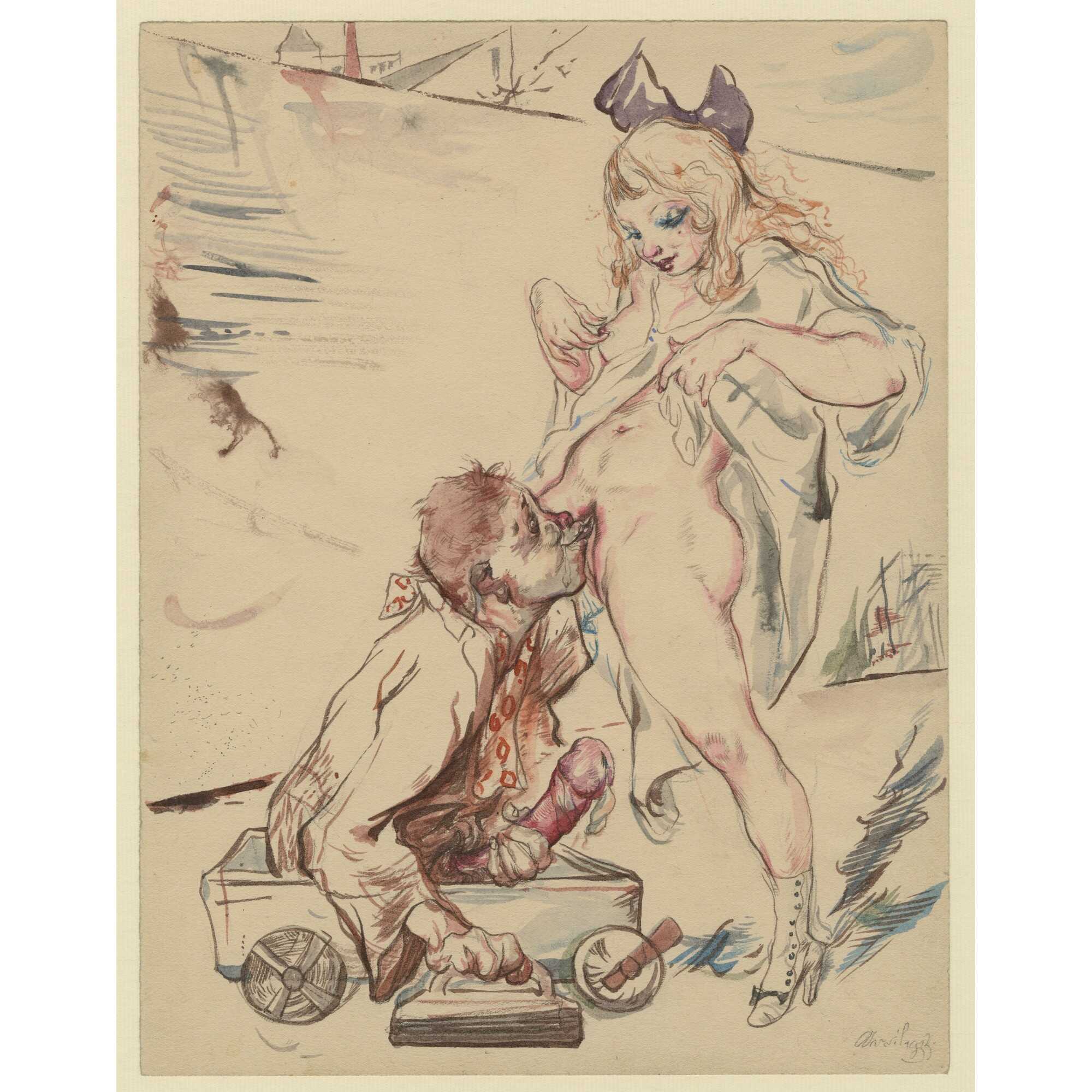
Watercolour drawing on wove paper, 327 × 252 mm, affixed along the upper margin to a cardstock support. Executed in a caricatural style, the composition depicts an erotic encounter between a legless invalid and a young woman in an outdoor setting. Dated in pencil at bottom right “Avril 1933.” Attributed by Jean-Pierre Dutel to Nicolas Sternberg.
"The Jewish Hungarian artist Nicolas Sternberg moved to Paris in the 1920s, remaining there for the rest of his life, hiding during the German occupation of the city in the 1940s under false identity papers." [MIA: Minneapolis Institute of Art, cited]
Jean-Pierre Dutel provides the following information:
Nicolas Sternberg was born to Jewish parents on July 9, 1902, in Nagyvárad, in Austro-Hungary. According to the archives of the Préfecture de police in Paris (1930), he was Hungarian. His real name was Miklós Szines-Sternberg. At the time, it was common among painters and sculptors to retain their original German names while adopting Hungarian-German double surnames. From age twelve, he worked as a newspaper illustrator in Budapest before moving to Paris in the early 1920s after studying in Munich. He published regularly in Paris-Soir, one of the most important French daily newspapers between the wars. Despite his talent, only one solo exhibition seems to have been dedicated to him at the Galerie Georges Petit (Georges Petit, 1856–1920) in 1929. Jules Pascin (1885 –1930) exhibited there in 1930 and committed suicide on the opening day.
Sternberg is known for his drawings devoted to the circus, madmen, and pornography. He excelled in portraits and self-portraits, particularly fine portraits of his wife Miche and his friend Michel Simon (1895–1975). In 1927, he made drawings for Les Flambeaux de la Noce, a play at the Comédie-Française. He also contributed to the illustration of La Légende des sexes by Edmond Haraucourt (1856 –1941). In 1930, he created illustrations for Les Aventures du Roi Pausole by Pierre Louÿs (1870–1925), published by Simon Kra (1853–1940), and for an edition of the bawdy songs Les Trois Orfèvres à la Saint Éloi, which led to an investigation into its publisher and illustrator. He also produced original watercolours for an edition of Manuel de Civilité by Pierre Louÿs. In 1933, he illustrated Madame de Pompadour by Paul Reboux (1877 –1963). In 1937, Sternberg illustrated Souls and Secrets, a collection of Hasidic stories by József Patai (1882–1953), translated by his son, the anthropologist, ethnologist, and historian Raphael Patai (Budapest, 1910 – Tucson, 1996), who kept some of Sternberg’s works in his home. Portraits of Michel Simon dating from 1932, along with numerous pornographic photographs of Sternberg taken by the actor between 1940 and 1960, demonstrate the longevity of their relationship.
In 1940, Sternberg miraculously escaped the Nazi’s aerial bombardment that killed several members of his family. During the Occupation, he lived in hiding with false papers and resumed his career in Paris after the war. Despite visual differences, Jules Pascin and Nicolas Sternberg shared some curious similarities. Their works, though employing different techniques, reflect the same underlying despair. Like Pascin, Sternberg committed suicide.
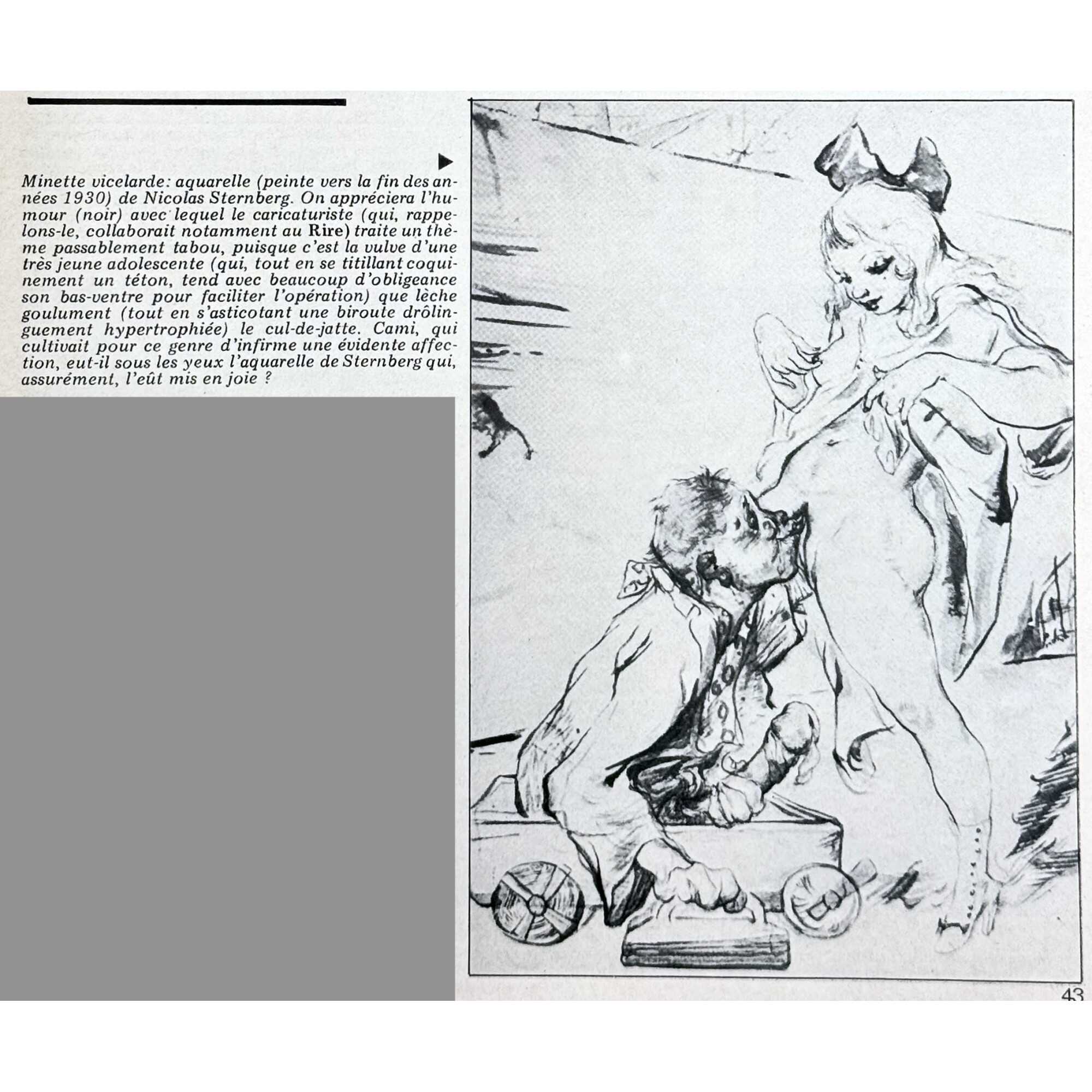
Note (January 10, 2026): The image is reproduced on p. 43 of Fascination, le Musée secret de l'érotisme, № 22, 1983; and was then part of the later published Fascination Album №8 (1985). The attribution is no longer in question; it is Nicolas Sternberg, indeed. The caption says:
Minette vicelarde: aquarelle (peinte vers la fin des années 1930) de Nicolas Sternberg. On appréciera l'humour (noir) avec lequel le caricaturiste (qui, rappelons-le, collaborait notamment au Rire) traite un thème passablement tabou, puisque c'est la vulve d'une très jeune adolescente (qui, tout en se titillant coquinement un téton, tend avec beaucoup d'obligeance son bas-ventre pour faciliter l'opération) que leche goulument (tout en s'asticotant une biroute drôlin-guement hypertrophiée) cul-de-jatte. Cami, qui cultivait pour ce genre d'infirme une évidente affection, eut-il sous les yeux l'aquarelle de Sternberg qui, assurément, l'eût mis en joie ?
Cami mentioned here is Pierre Cami (full name Pierre Louis Adrien Charles Henry Cami, French, 1884–1958).
Additional Information
| Collection | Erotica , European prints and drawings |
|---|---|
| Type / Purpose | Drawing |
| Period | 20 AD , Mid-20th Century |
| Country | France |
| Media/Technique | Paper , Watercolour , Wove paper |
| Subject | 20th century , Caricature , Drawing , Erotica , France , Humour , Paintings and drawings , Sex , Sexual behavior and attitudes , Sexual life , Sexuality , The First World War (1914–1918) , Veterans , Women |
| Creation / Publishing year | 1945 |
| Acquisition year | 2025 |


