
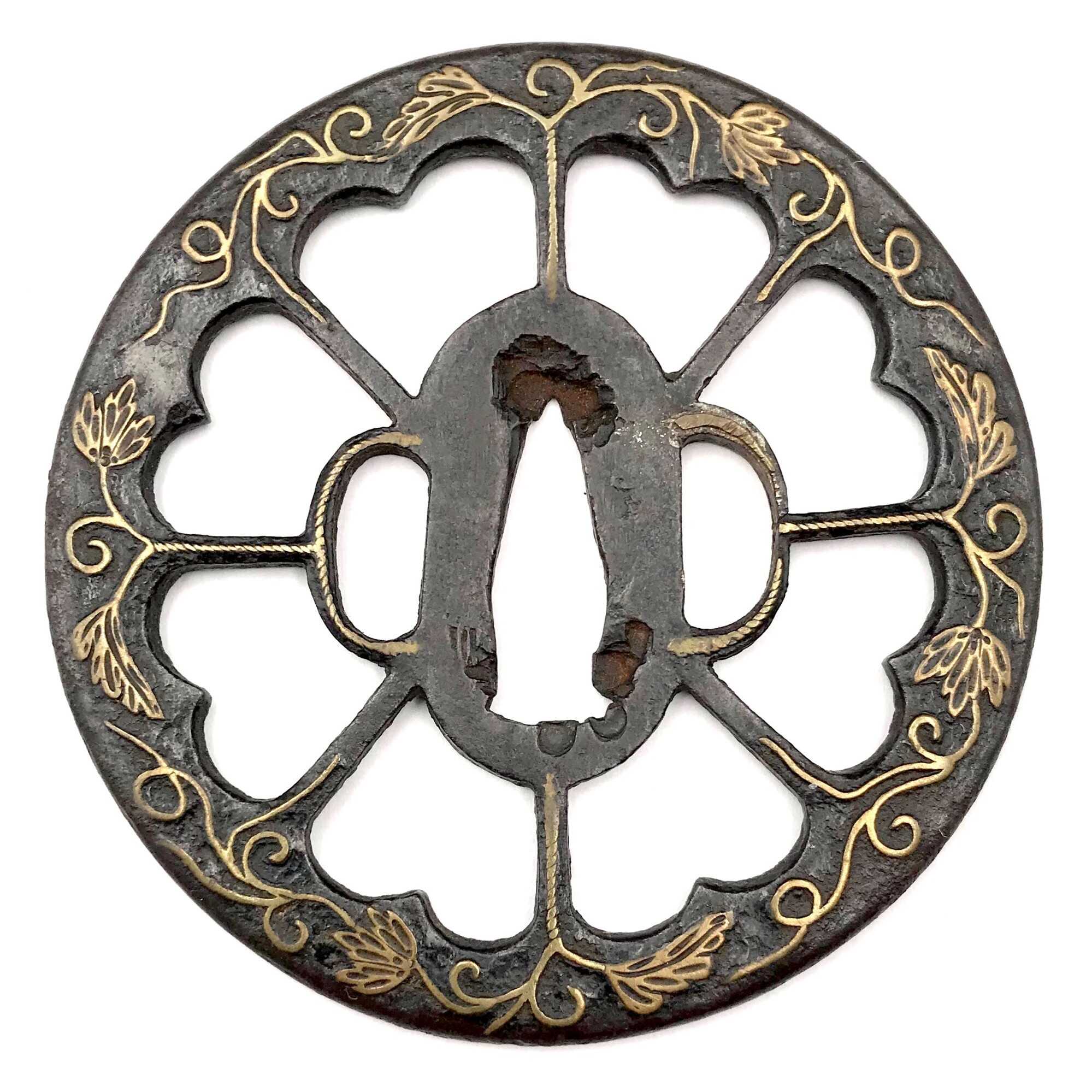
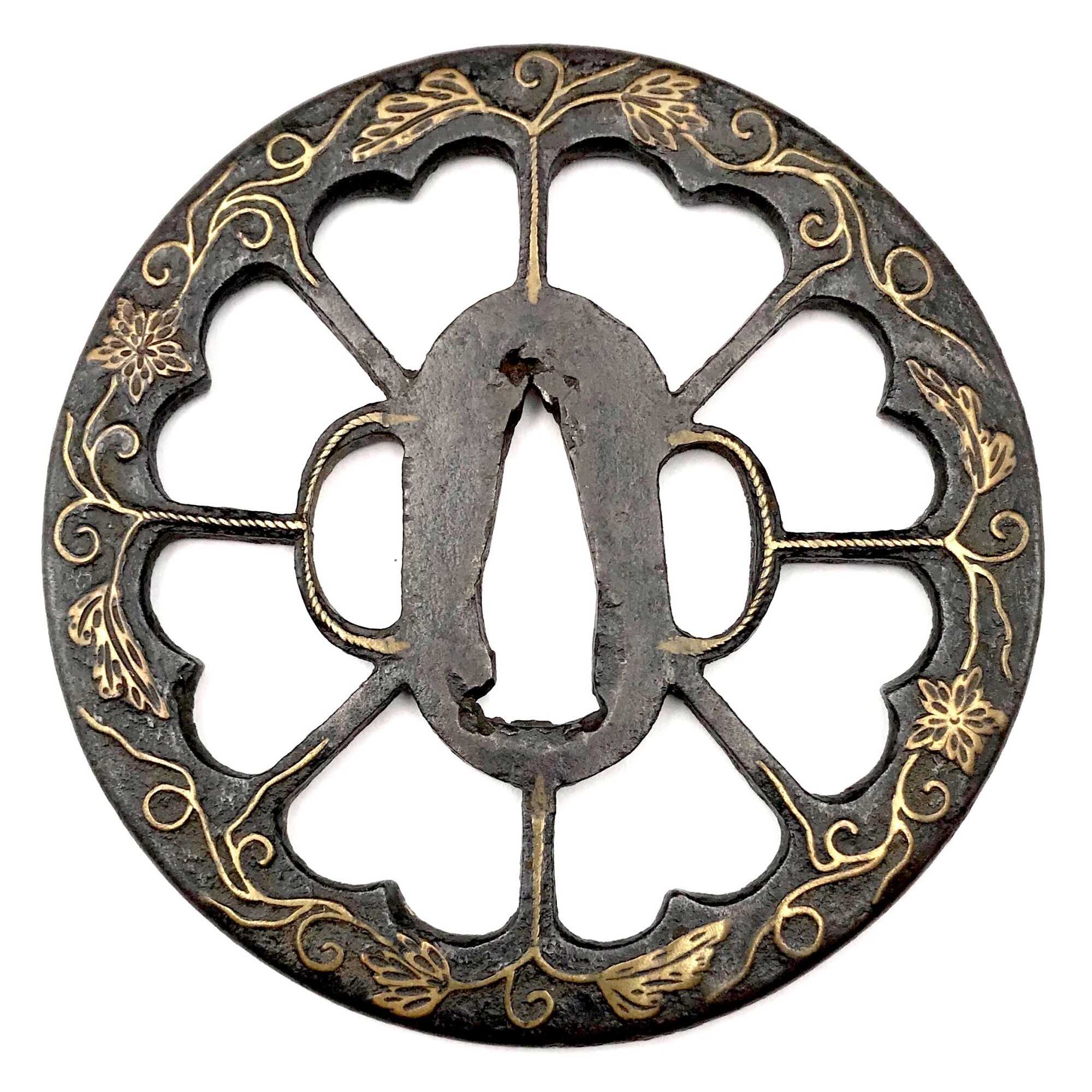
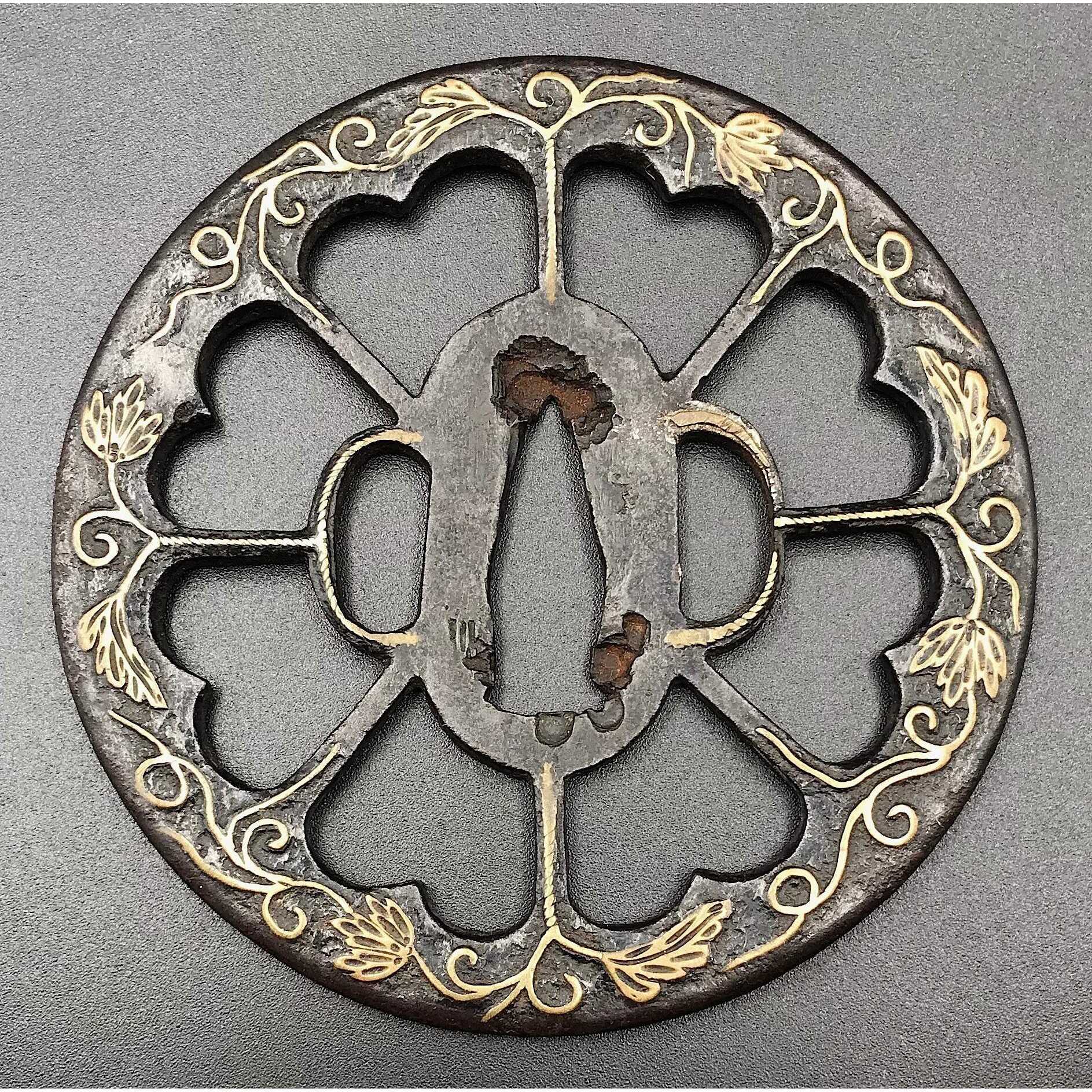
Iron tsuba of round form represents an eight-spoke Wheel-of-the-Law and in the same time (because of the inner shape of cut-outs) - a sixteen-petal imperial chrysanthemum in openwork (sukashi). Decorated on both sides with vines, leaves, and tendrils in suemon-zōgan and sen-zōgan. Spokes and hitsu-ana decorated with rope-like linear brass inlay (nawame-zōgan).
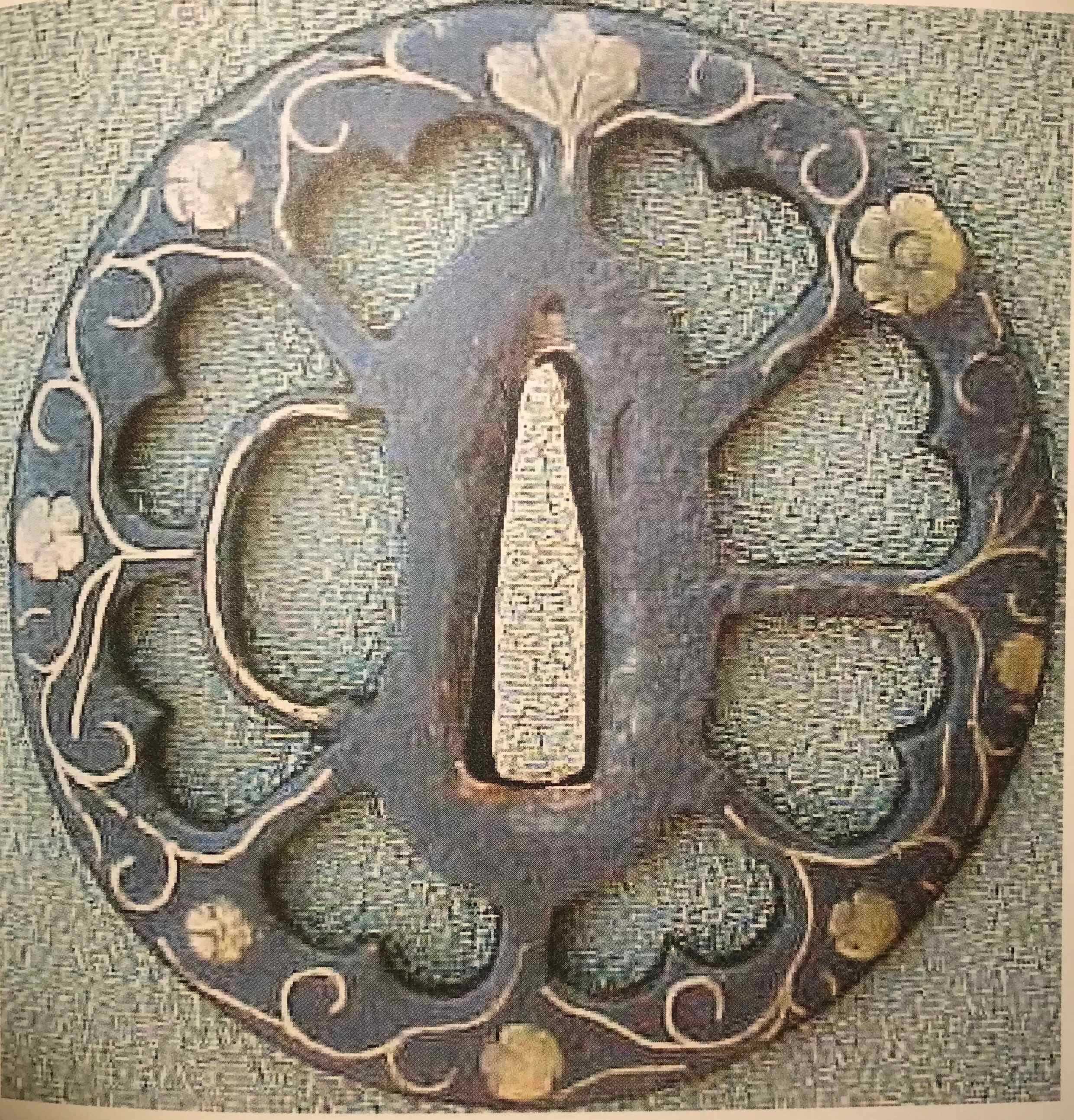
A somewhat look-a-like tsuba is referenced in Gary D. Murtha's Japanese Sword Guards. Onin-Heianjo-Yoshiro book on page 61. Mr. Murtha attributes his piece to Heianjo school of Azuchi-Momoyama or early Edo period. However, tsuba in this collection looks older and bolder than the one in his book. It is larger (84 mm vs. his 66 mm), the spokes are longer, the inlay is of better quality, it is relatively thin, with deep black patina, and with the traces of lacquer (urushi). This may indicate that this tsuba belongs to Ōnin school and dates at least to late Muromachi period, ca. 1550, if not 1450 AD.
Mid to late Muromachi period (ca. 1450-1550).
Dimensions: 84.3 x 83.2 x 3.2 mm
"In Japan, the Wheel-of-the-Law is an attribute of such deities as Senju Kannon, the Thousand-Armed Kannon, and Dainichi Nyorai, the principal deity of Shingon Buddhism [Merrily Baird]. May be used as a family crest (mon).
Additional Information
| Collection | Japanese swords & fittings |
|---|---|
| Type / Purpose | Tsuba |
| Country | Japan |
| Period | 16 AD , Muromachi period [室町時代] (1336–1573) |
| School | Heianjō School , Ōnin School |
| Subject | Chrysanthemum (kiku) , Wheel (kuruma) , Wheel-of-the-Law (rimbo, kinrin) |
| Media/Technique | Nawame-zōgan , Sen-zōgan , Suemon-zōgan |
| Material | Brass , Iron |
| Acquisition year | 2014 |
Related Items


