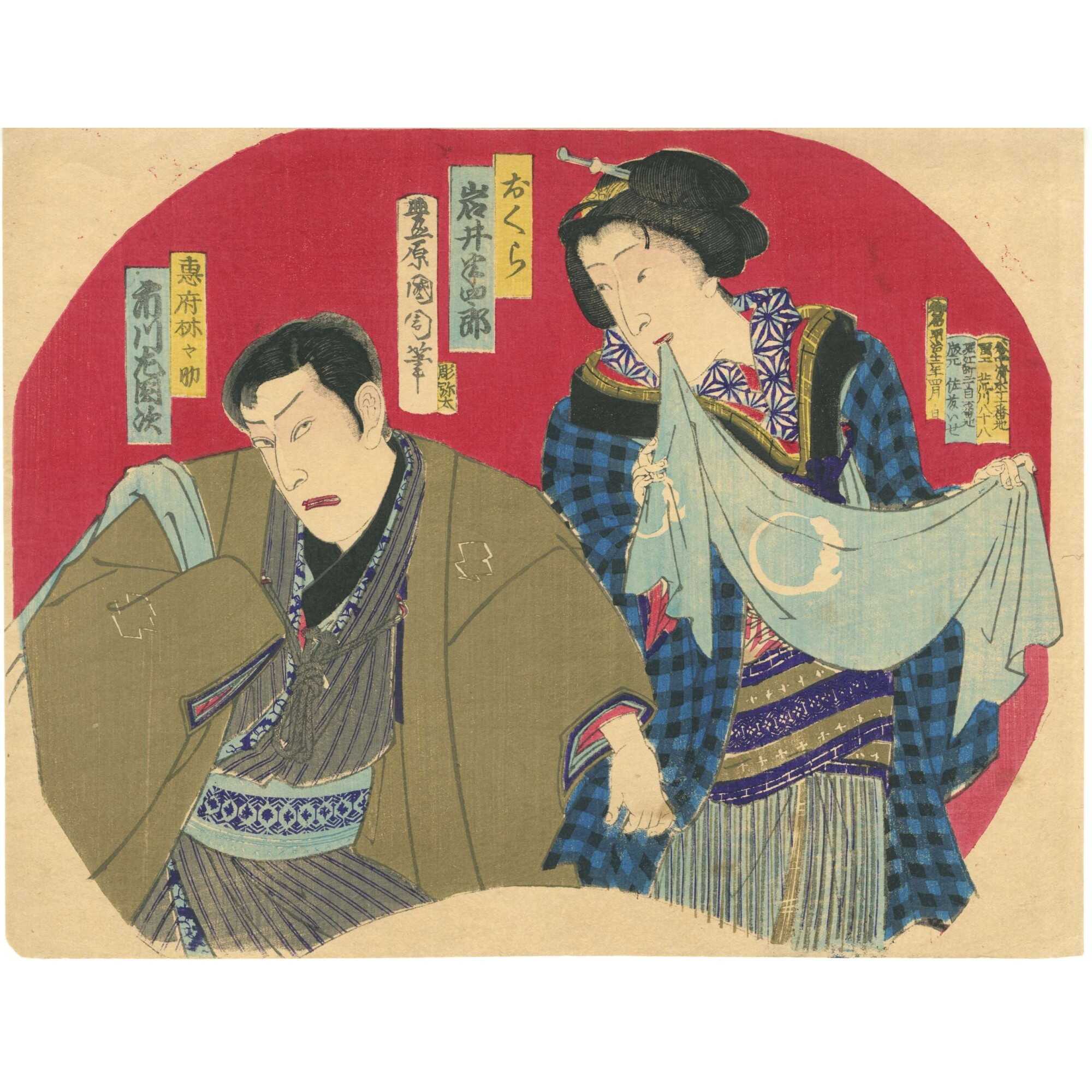
Artist: Toyohara Kunichika (豊原国周, 1835–1900), a.k.a. Arakawa Yasohachi (荒川 八十八)
Signed: Toyohara Kunichika hitsu (豊原國周筆)
Publisher: Satō Ise (佐藤いせ); 堀江町二丁目一番地 板元 佐藤いせ; Horiechō Nichōme 1-banchi, hanmoto Satō Ise
Block carver: Watanabe Yataro [渡辺弥太郎] (Japanese, 1850 – 1913); seal: hori Yata (彫弥太)
Date: 12th year of the Meiji era, 4th month (明治十二年 四月); 4/1879
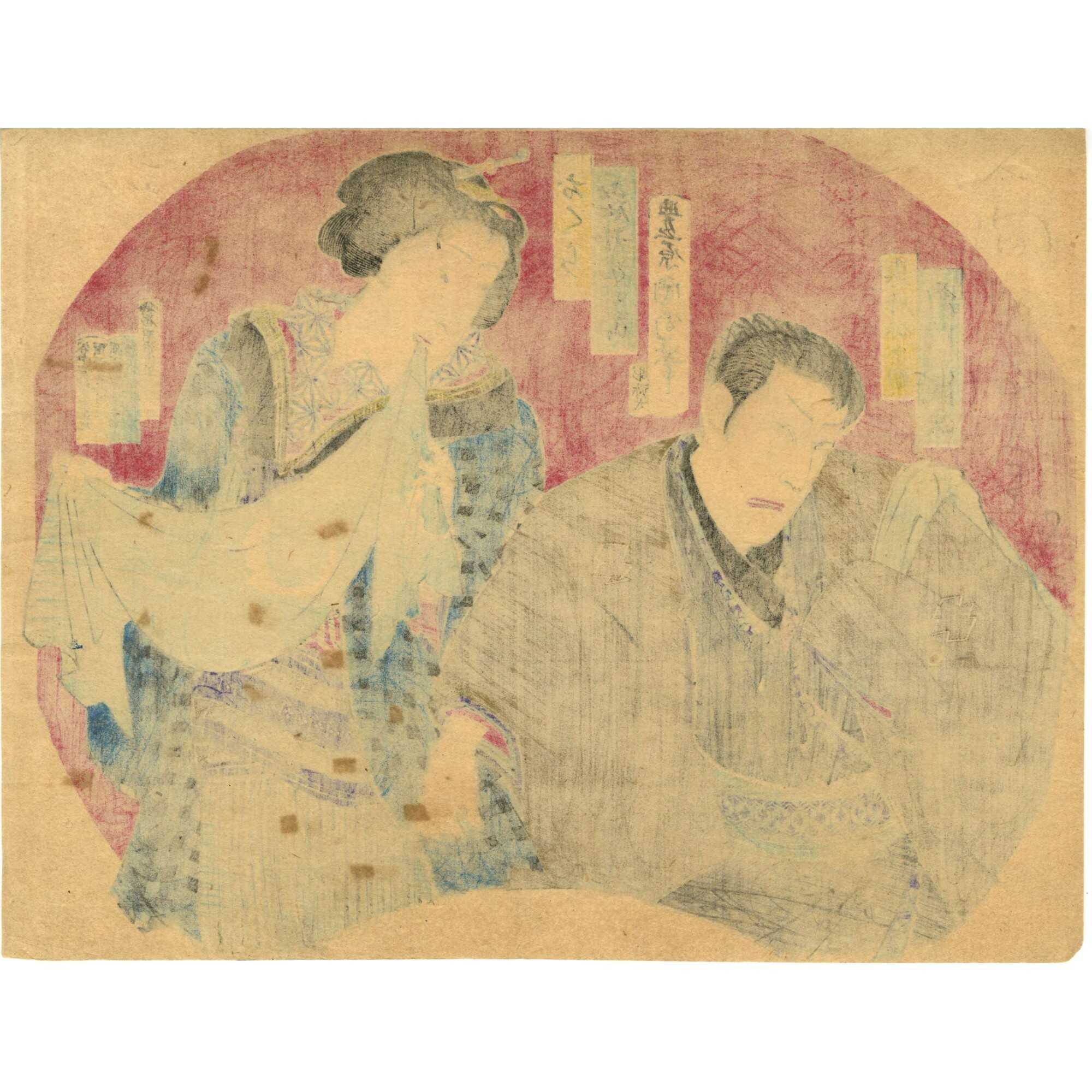
Media: Aiban yoko-e uchiwa-e (合判横絵団扇絵); Fan print, color woodblock print, 227 x 295 mm
Actors and Roles:
- Ichikawa Sadanji I [市川左団次, old writing 市川左團次] (Japanese, 1842 – 1904); other names: Ichikawa Shōjaku I, Ichikawa Koyone, Ichikawa Tatsuzō.
- Iwai Hanshirō VIII [岩井半四郎] (Japanese, 1829 – 1882); other names: Iwai Shijaku II, Iwai Kumesaburō III [岩井粂三郎], Iwai Hisajirō II.
Play: Ningen Banji Kane no Yo no Naka (人間万事金世中 - にんげんばんじかねのよのなか), performed on the 2nd month of Meiji 12 (2/1879) at Shintomi-za, Tokyo; the title translated as “Money Makes the World Go Round” (Samuel L. Leiter, 2014). A katsureki (realistic historical drama) written by Kawatake Mokuami [河竹黙阿弥] (Japanese, 1816 – 1893). The title is a witty inversion of a well-known Confucian saying, "Everything in life is about money". The play title is not written on the print.
Efu Rinnosuke’s father once ran a porcelain wholesale business in Yokohama, but after dabbling unsuccessfully in market speculation, he lost the family fortune. Following his father's death from illness, Rinnosuke was taken in by his uncle, Henmi Seizaemon, a merchant who operated a foreign trade business in Yokohama’s Sakaichō district.
Seizaemon was a miserly and unscrupulous man who treated his nephew little better than a shop apprentice, sending him out to collect debts and handle other menial tasks. Seizaemon’s wife, Oran, had a niece named Okura. She, too, had once been the daughter of a prosperous raw silk wholesaler, but after her father’s business collapsed and both parents died of illness, Okura was taken into the Henmi household. There, she was likewise treated as a servant, forced to work under harsh and humiliating conditions.
*) Comment from Horst Graebner:
Although this print bears an inscription identifying the male actor as Ichikawa Sadanji I in the role of Efu Rinnosuke (恵府林之助), comparative analysis of multiple prints strongly suggests that the figure depicted is, in fact, Onoe Kikugorō V [五代目尾上菊五郎]. The facial features and stylistic portrayal closely match his likeness in other prints from the same performance (see Hankyu Culture Archive).
This conclusion is further supported by record from the Waseda University Cultural Resource Database, which confirms that the role of Efu Rinnosuke was performed by Onoe Kikugorō V. Ichikawa Sadanji I, by contrast, is recorded as having played the roles of the rice dealer Takayasu Tokujirō (米商高安徳次郎) and Sunada Tsuzō (寿無田宇津蔵).