Inscriptions:
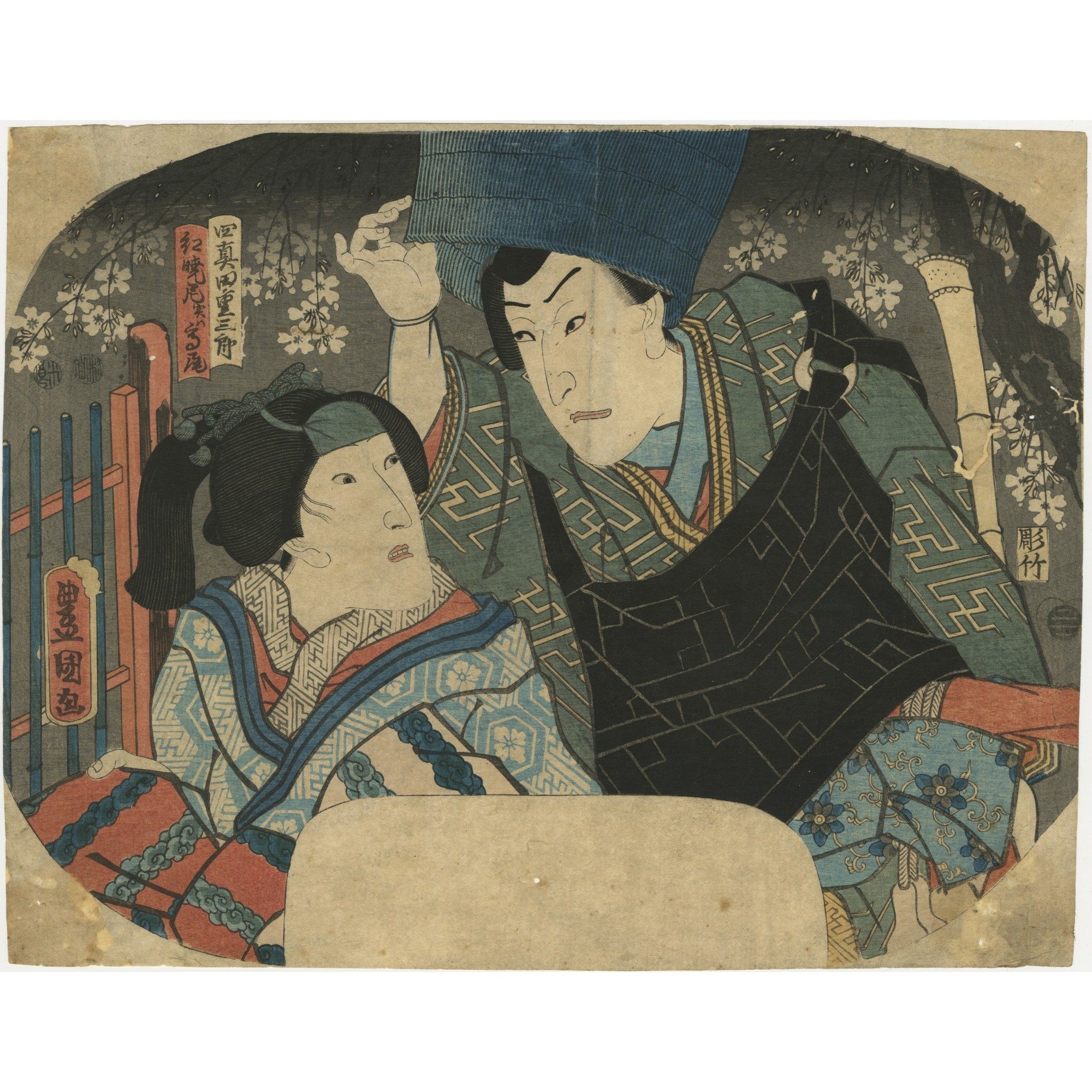
Signature: Toyokuni ga [豊國画], in a red toshidama cartouche, lower left
Censors: Mera [目良], Murata [村田], active together from 2/1847 to 11/1850, upper left
Block carver: hori Take [彫竹], in a white rectangular cartouche (Yokogawa Takejirō [横川竹二郎]), centre-right
Publisher: sun-in-circle device within a heart-shaped seal (Ibaya Sensaburō [伊場屋仙三郎]), centre-right
Roles: Kugyō ni jitsuwa Takao [紅暁尼実ハ高尾] and Shimada Jūzaburō [四真田重三郎], in red and white vertical cartouches respectively, upper left
Description:
Aiban yoko-e uchiwa-e (団扇絵), 230 × 294 mm. Half-length composition with two kabuki actors in an outdoor scene. At left, Onoe Baikō IV as Kugyō, in reality Takao (Kugyō ni jitsuwa Takao; 紅暁尼実ハ高尾), turns upward toward the male figure—Sawamura Chōjūrō V as Shimada Jūzaburō (四真田重三郎), who raises his komusō hat (tengai, 天蓋) with his right hand, revealing his face; his flute (shakuhachi, 尺八) is tucked under his left arm. The scene derives from Kōshoku Shimada monogatari (好色島田語; “Amorous Tale of Shimada”), a kabuki play involving disguise and role transformation. Takao (高尾) refers to a celebrated courtesan name of the Yoshiwara, most famously associated with the high-ranking oiran of the Miuraya (三浦屋). In this play, she appears under the assumed identity of the nun Kugyō (紅暁尼).
Actors:
Onoe Baikō IV [尾上梅幸] (Japanese, 1808–1860); other names Onoe Kikugorō IV, Onoe Eizaburō III, Onoe Kikue, Nakamura Tatsuzō, Nakamura Kachō; Guild: Otowaya [音羽屋]
Sawamura Chōjūrō V [沢村長十郎] (Japanese, 1802–1853); other names Sawamura Gennosuke II, Suketakaya Takasuke III, Sawamura Sōjūrō V, Sawamura Tosshō I, Sawamura Genpei I, Sawamura Tosshi V; Poetry names: Kōga, Tosshi V, Tosshō; Guild: Kinokuniya [紀の国屋]
Roles:
Kugyō ni jitsuwa Takao [紅暁尼実ハ高尾] — the nun Kugyō, in reality Takao
Shimada Jūzaburō [四真田重三郎]
Play: Kōshoku Shimada monogatari [好色島田語] — Amorous Tale of Shimada
Theater: Ichimura-za [市村座], Edo (Tokyo)
Performance date: 3rd month, 1850 (Kaei 3)