
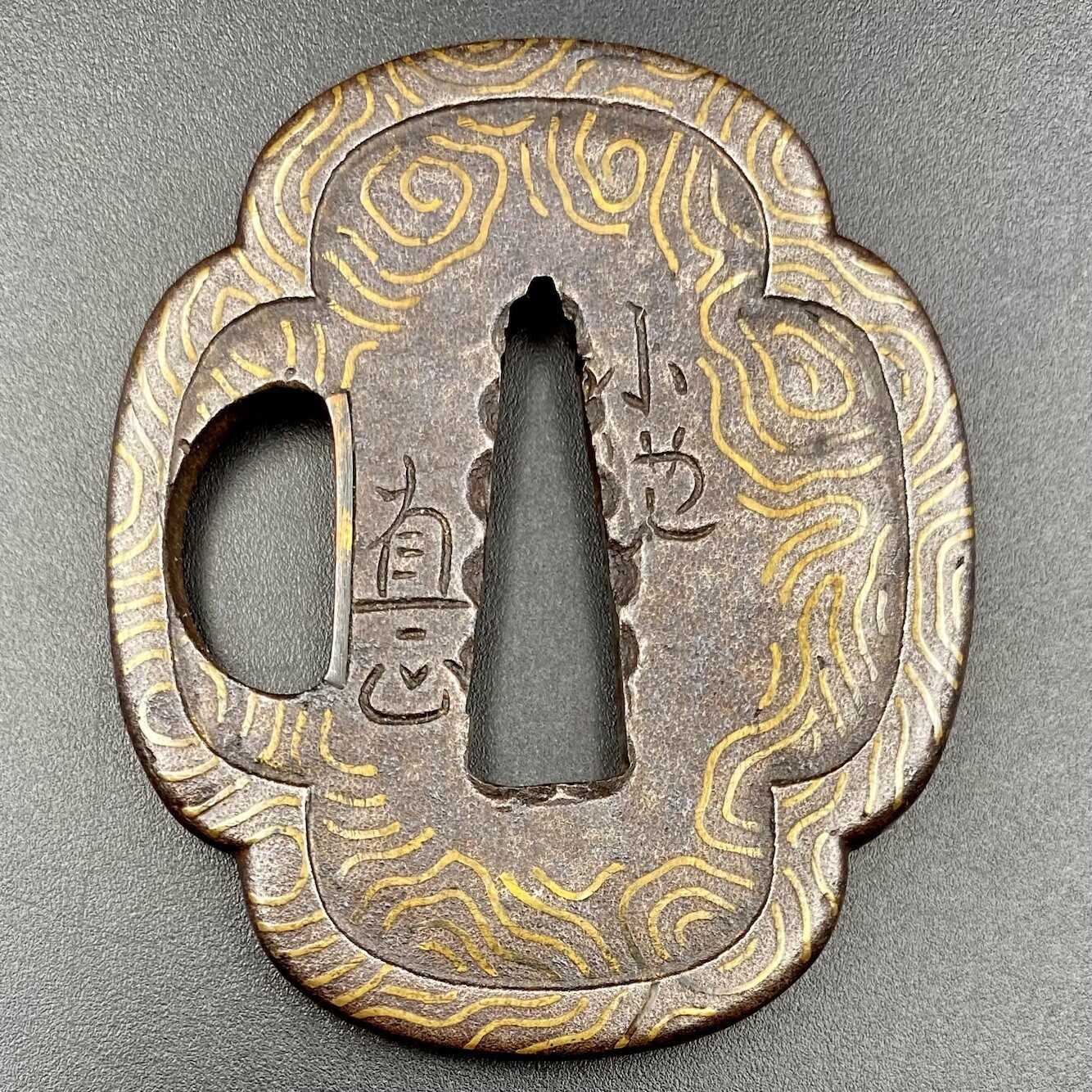
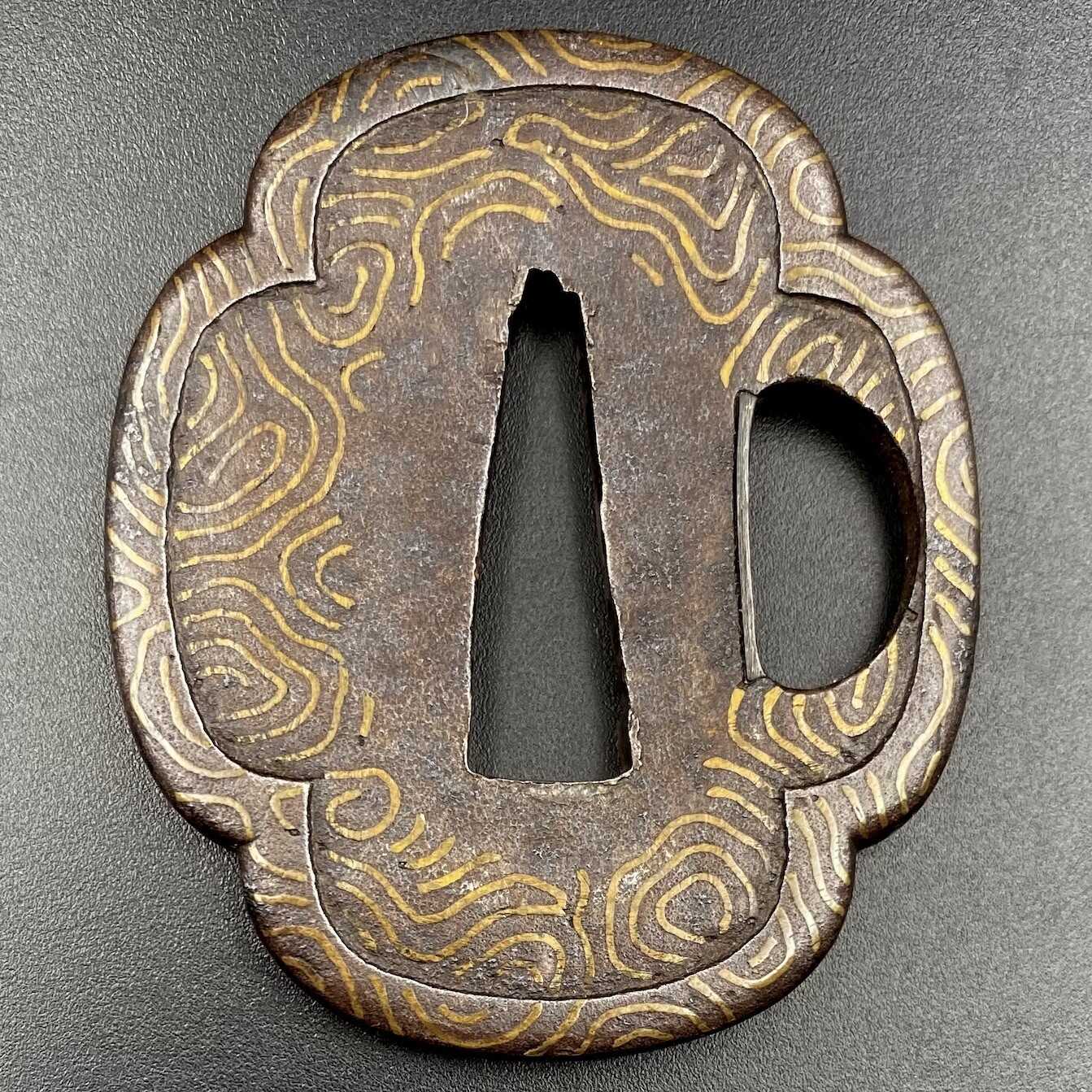
Small iron tsuba for a dagger (tantō), of quatrefoil form (mokkō-gata), with raised rim (mimi), decorated with flat brass inlay (hira-zōgan) to form an abstract design alluding to the mushroom of immortality (reishi). Opening (hitsu-ana) to the left of nakaga-ana probably cut later and fitted with shakudo sekigane. Maker's signature on seppa-dai: Koike Naomasa (小池 直正).
Momoyama period: End of the 16th - beginning of the 17th century.
Dimensions: Height 53.7 mm; Width: 45.5 mm; Thickness at centre: 3.5 mm; at rim: 4.9 mm.
Other examples of signed Koike Naomasa work in this collection: TSU-0346.
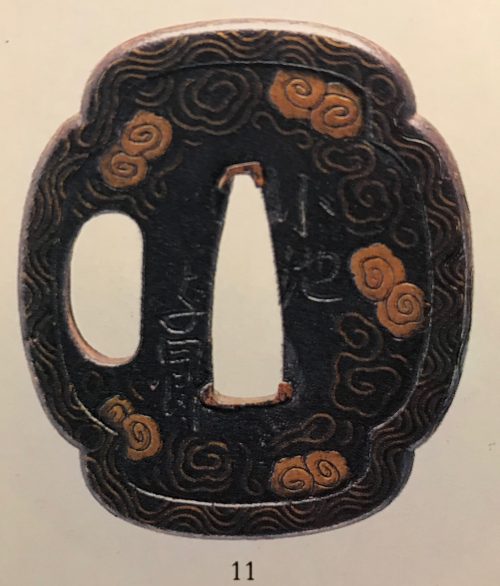
Reference: The closest example in literature is in Compton Collection (II): №11 with the description: “A Koike School tsuba, Edo period (circa 1625), signed Koike Yoshiro. Sheet-brass flush inlay of cloud forms and wire inlay creating the same shape. Koike Yoshiro Naomasa worked from the Keicho to the Genna periods (1596-1623). He arrived in Kyoto from Kaga.” [Japanese Swords and Sword Fittings from the Collection of Dr. Walter Ames Compton (Part II) / Sebastian Izzard, Yoshinori Munemura. — Christie's, New York, October 22, 1992]. See: Yoshirō tsuba.
Additional Information
| Collection | Japanese swords & fittings |
|---|---|
| Type / Purpose | Sword hand guard , Tsuba |
| Country | Japan |
| Period | 16 AD , 17 AD , Azuchi–Momoyama period [安土桃山時代] (1568–1603) |
| School | Yoshirō School |
| Subject | Mushroom of immortality (reishi) |
| Media/Technique | Hira-Zōgan , Inlay |
| Material | Brass , Iron |
| Acquisition year | 2022 |
Related Items


