
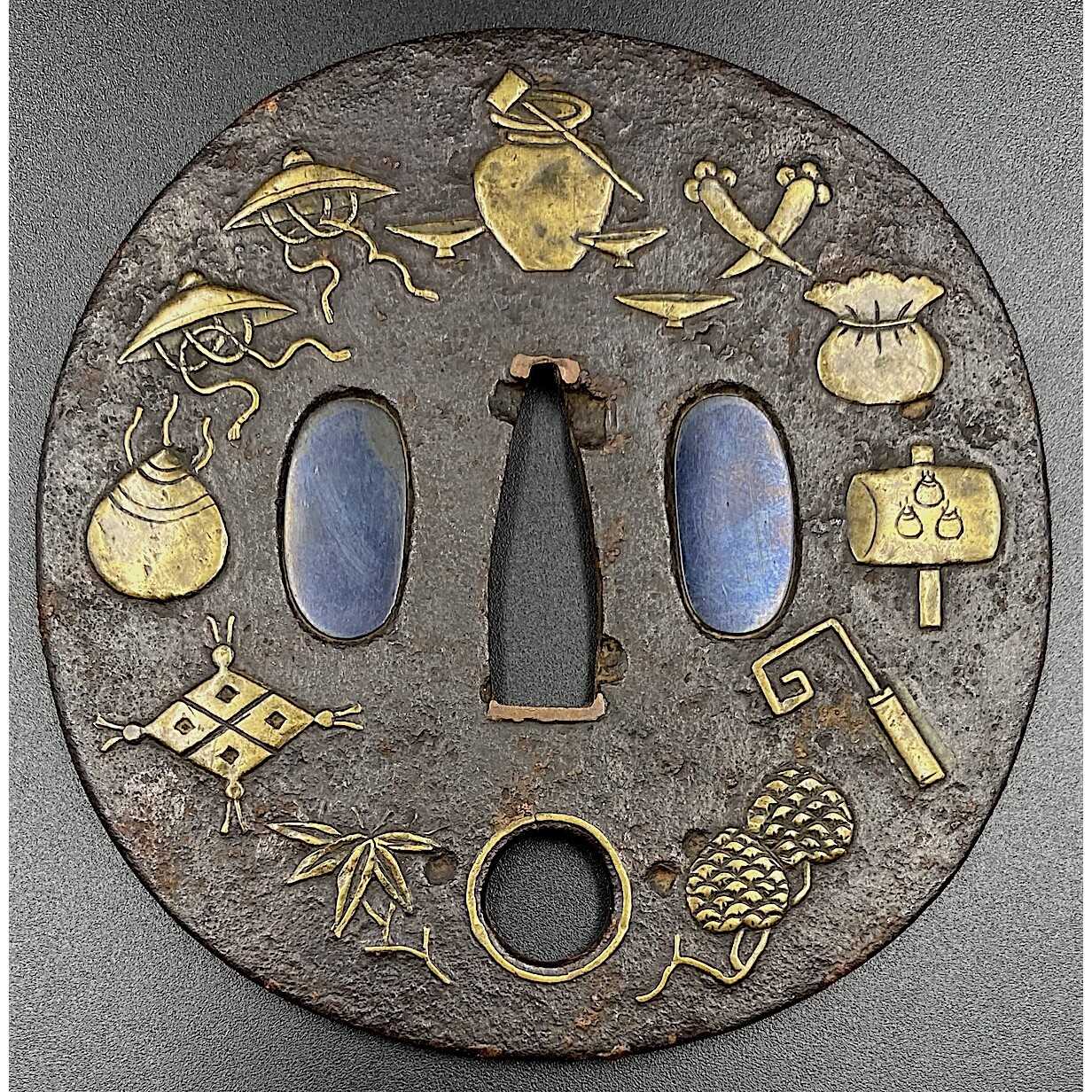
Iron tsuba of almost round form with a brass outlined circular opening (sukashi) in the bottom adorned with the Myriad Treasures [takaramono, 宝物] and winter motifs inlaid in cast brass (suemon-zōgan); hitsu-ana possibly cut later, both plugged with shakudo, nakaga-ana fitted with copper sekigane. According to Merrily Baird*) (2001), the symbolism of Myriad Treasures “is associated with the Seven Gods of Good Luck, who carry them in a sack”. Among the treasures, which are said to ensure prosperity, long life, and general good fortunes, are (reading clockwise from the top):
- Sake set [shuki, 酒器], namely flask, ladle, and cups
- Cloves [choji, 丁子]
- Purse of inexhaustible reaches [kinchaku, 巾着]
- Magic mallet [kozuchi, 小槌]
- Key to the storehouse of the Gods [kagi, 鍵]
Then, Pine, Moon, and Bamboo (see below);
- Rhombus, or Lozenge (hosho, 方勝), with the second ideograph meaning victory.
- Sacred (or wish-granting) gem, or jewel [hōju, 宝珠]
- Hats of invisibility [kakuregasa, 隠れ笠]
The Myriad Treasures is carried by the Seven Gods of Good Luck (a.k.a. the Seven Lucky Gods or Seven Gods of Fortune [shichifukujin, 七福神], who are transported by the Treasure Ship [takarabune, 宝船] during the first three days of the New Year.
Pine, Moon, and Bamboo: bamboo [take, 竹] and pinecones [matsukasa, 松笠], or pine [matsu, 松] – two of the Three Friends of Winter [shōchikubai, 松竹梅] – symbolize fidelity, fortitude, steadfastness, perseverance, and resilience. The third ‘friend’ – plum, [ume, 梅] – in this case replaced by the Moon [tsuki, 月] – large (11 mm) circular opening at 6 o’clock; the three small carved dots represent the dewdrops.
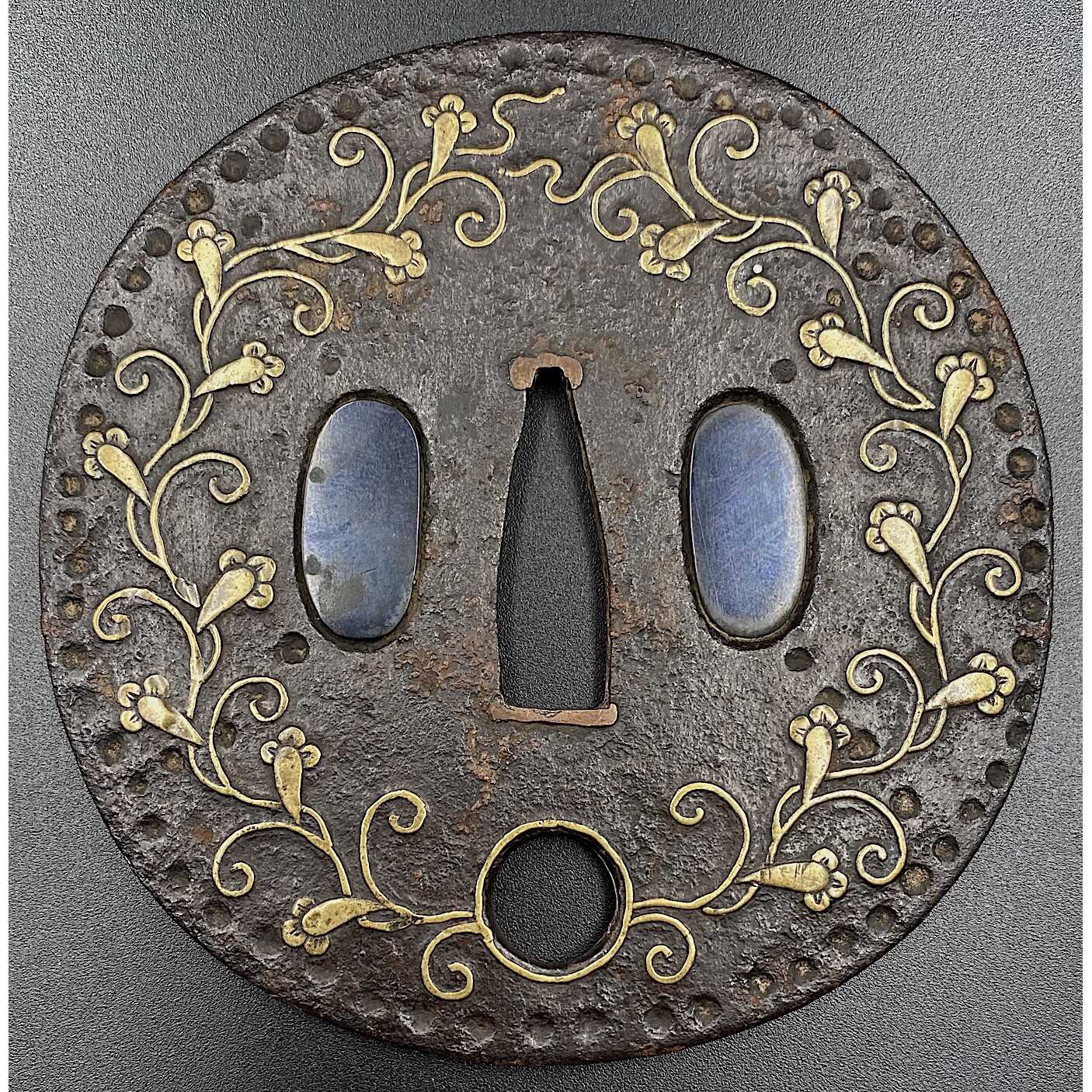
The other side is decorated with an arabesque (karakusa) of cloves and vines, with carved dots (dewdrops) along the rim.
The overall New Year / Winter connotation of the tsuba is clear. The prominence of the Moon conveys purity, coldness (sadness/loneliness), and slenderness – the inherent qualities of a samurai.
H: 93 mm x W: 90 mm, thickness 4.2 mm at the centre, slightly tapered towards the rim.
*) Merrily Baird. Symbols of Japan: Thematic motifs in art and design. — NY: Rizzoli international publications, 2001.
Seller’s description: École Heianjo - Début Époque EDO (1603 - 1868). Nagamaru gata en fer à décor incrusté en hira-zogan de laiton de tama, choji, jarre à saké et des attributs de Daikoku (maillet, chapeau d'invisibilité et sac de richesse) et de branches de choji de l'autre côté et ajourée en kage-sukashi d'un cercle. H. 9,2 cm
Additional Information
| Collection | Japanese swords & fittings |
|---|---|
| Type / Purpose | Sword hand guard , Tsuba |
| Country | Japan |
| Period | 16 AD , 17 AD , Azuchi–Momoyama period [安土桃山時代] (1568–1603) , Early 17th century , Edo period [江戸時代] (1603–1868) , Late 16th century |
| School | Heianjō School |
| Subject | Arabesque (karakusa) , Moon , Myriad Treasures [takaramono, 宝物] , Vines , Winter |
| Media/Technique | Inlay , Suemon-zōgan , Sukashi |
| Material | Brass , Iron |
| Acquisition year | 2023 |
Related Items


