
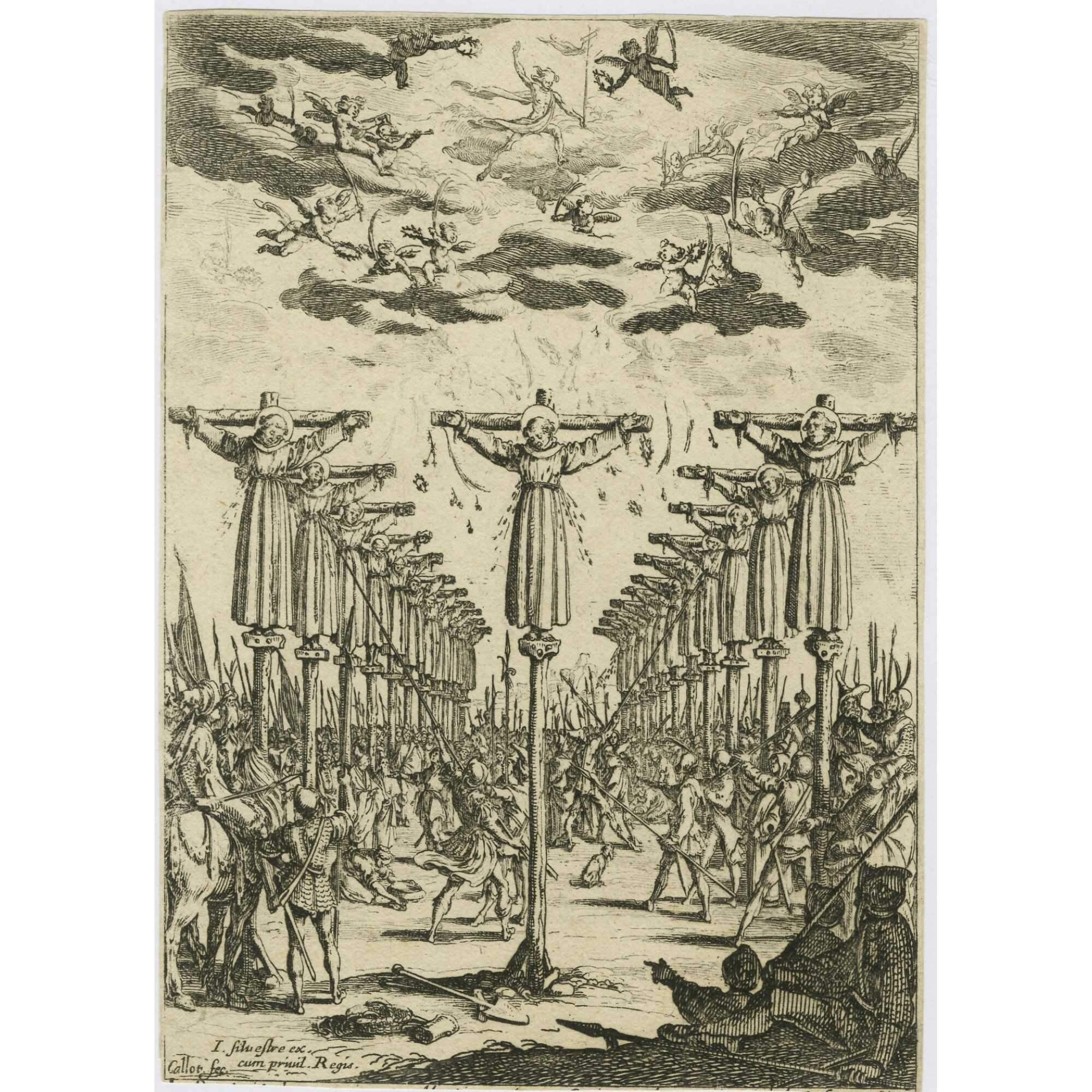
Artist: Jacques Callot (French, 1592–1635)
Publisher: Israel Silvestre (French, 1621–1691)
Signed: Callot fec. (etched by Callot); I. Siluestre ex. cum privil. Regis (published by Israel Silvestre, Paris, after 1661)
Date: ca. 1627–1628 (plate); published after 1661
Medium: Etching on cream antique laid paper; 159 × 113 mm (sheet); platemark 161.7 × 113 mm (Lieure); 1 mm margins
Title: The Martyrs of Japan (Les Martyrs du Japon)
Series/Portfolio: The Combat at the Barrier (Le Combat à la Barrière)
Catalogue Raisonné: Lieure 594 (vol. II, p. 89); M. 155 (Mariette)
Description:
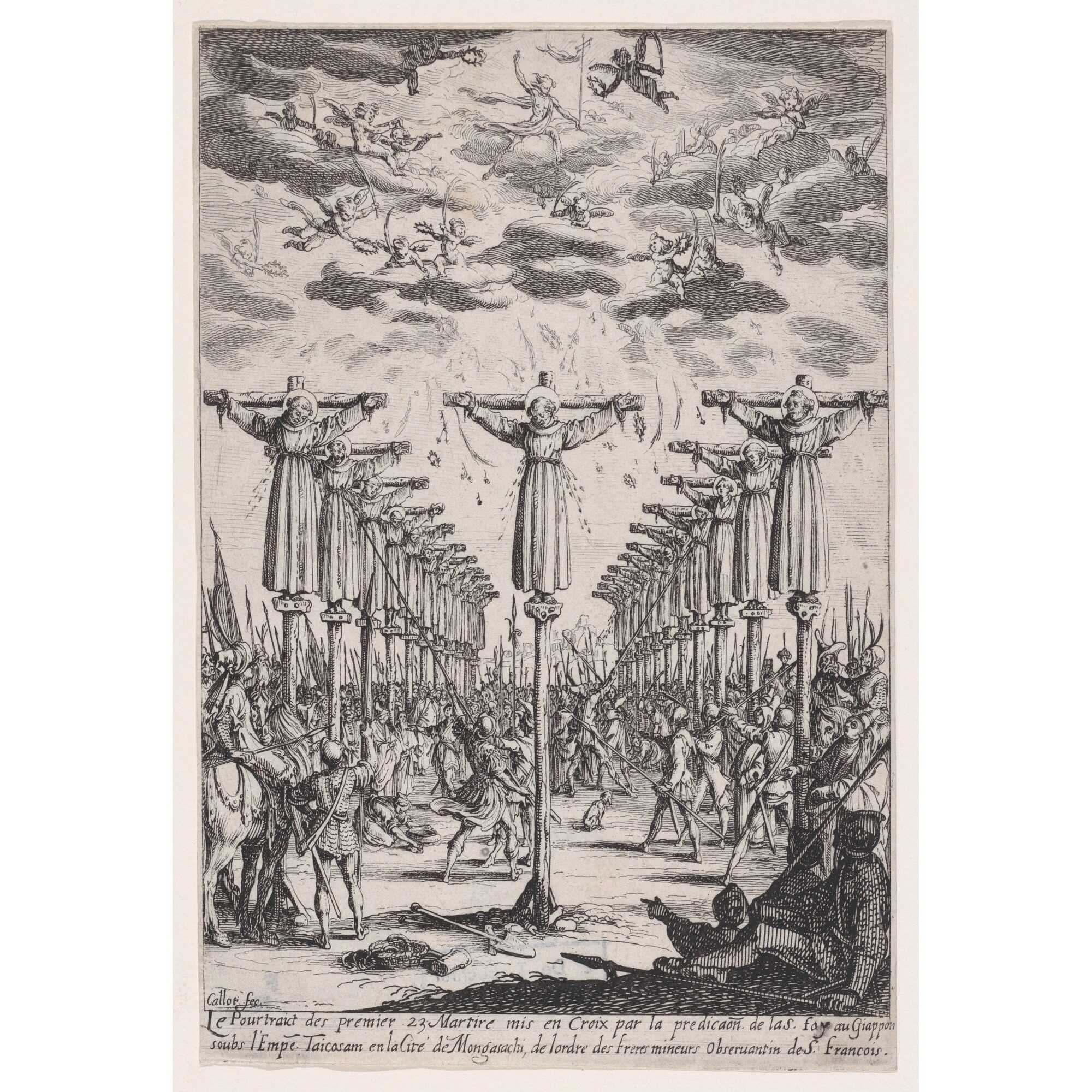
Callot’s small etching commemorates the martyrdom of twenty-six Christians executed in Nagasaki on 5 February 1597, canonised as the Martyrs of Japan. Of these, twenty-three were Franciscan friars, shown here in long habits, their arms bound to tall crosses planted in a double row receding in perspective. Soldiers with lances stand below, actively piercing the victims’ sides. To the left, one figure collapses under the thrust of a spear, while others look upward in resignation. In the sky above, a heavenly vision unfolds: cherubim and angels descend with wreaths and palms of martyrdom; one angel carries a crown. At the upper right, a grotesque demon flees amid clouds, balancing the triumphal imagery with a note of Counter-Reformation contrast.
The martyrdom depicted here took place under the rule of Toyotomi Hideyoshi (豊臣 秀吉, 1537–1598), after the wreck of the Spanish ship San Felipe (1596) heightened suspicions of Christian missionary activity as a prelude to Iberian conquest. Rivalries between Portuguese Jesuits and Spanish Franciscans, along with emerging Dutch and English commercial missions, contributed to the climate of hostility toward foreign religions in Japan.
The composition is framed by a rectangular border line. In the first state, the lower margin contained a large cartouche with an inscription identifying the martyrs: “Le Portrait des premiers 23 Martires mis en Croix par le commandement de la Roy du Giapon l’an 1597. Le 5 de Feurier…” (full text in Lieure). In the second state, to which this impression belongs, the cartouche was removed, and the publisher’s inscription added: I. Siluestre ex. cum privil. Regis.
States:
– First state (Callot, c. 1627–28): with an inscribed cartouche describing the event.
– Second state (Israel Silvestre, after 1661): cartouche erased; privilege line added.
Interpretation:
This etching belongs to the series Le Combat à la Barrière, though it circulated independently as a devotional sheet. It reflects Counter-Reformation iconography, emphasizing the heroic endurance of Franciscan missionaries and presenting their deaths as a celestial triumph. The work was reissued after Callot’s death by his nephew Israel Silvestre, who inherited many of his plates.
Sourse: Jules Lieure. Jacques Callot / Introduction de F. Courboin (Vol. 1-3). — Paris: Gazette des Beaux-Arts, 1924-27. [LIB-3253.2023]
Additional Information
| Collection | European prints and drawings , Japan: art, history, literature |
|---|---|
| Type / Purpose | |
| Period | 17 AD , Late 17th century , Mid-17th century |
| Country | France |
| Media/Technique | Copperplate engraving , Engraving , Etching , Laid paper , Paper |
| Genre | Historical Images , Religious Images |
| Subject | 17th century , Angels , Azuchi-Momoyama period (1568–1600) , Catholic Church , Christian missionaries , Christianity , Colonialism , Counter-Reformation , Crucifixion , Demons , Dutch history , History , History of Christianity , Japan , Japanese history , Martyrdom , Martyrdom of the Twenty-Six Martyrs of Nagasaki (1597) , Military , Nagasaki (city) , Politics , Propaganda , Toyotomi Hideyoshi (Japanese, 1537–1598) |
| Creation / Publishing year | 1627 , 1628 , 1661 |
| Catalogue raisonne | J. Lieure (1927) |
| Acquisition year | 2025 |
Related Items


