

Artist: Torii Kiyonaga [鳥居 清長] (Japanese, 1752 – 1815)
Media: Colour woodblock print, makimono-e, 125 x 660–700 mm
Date: c. 1785.
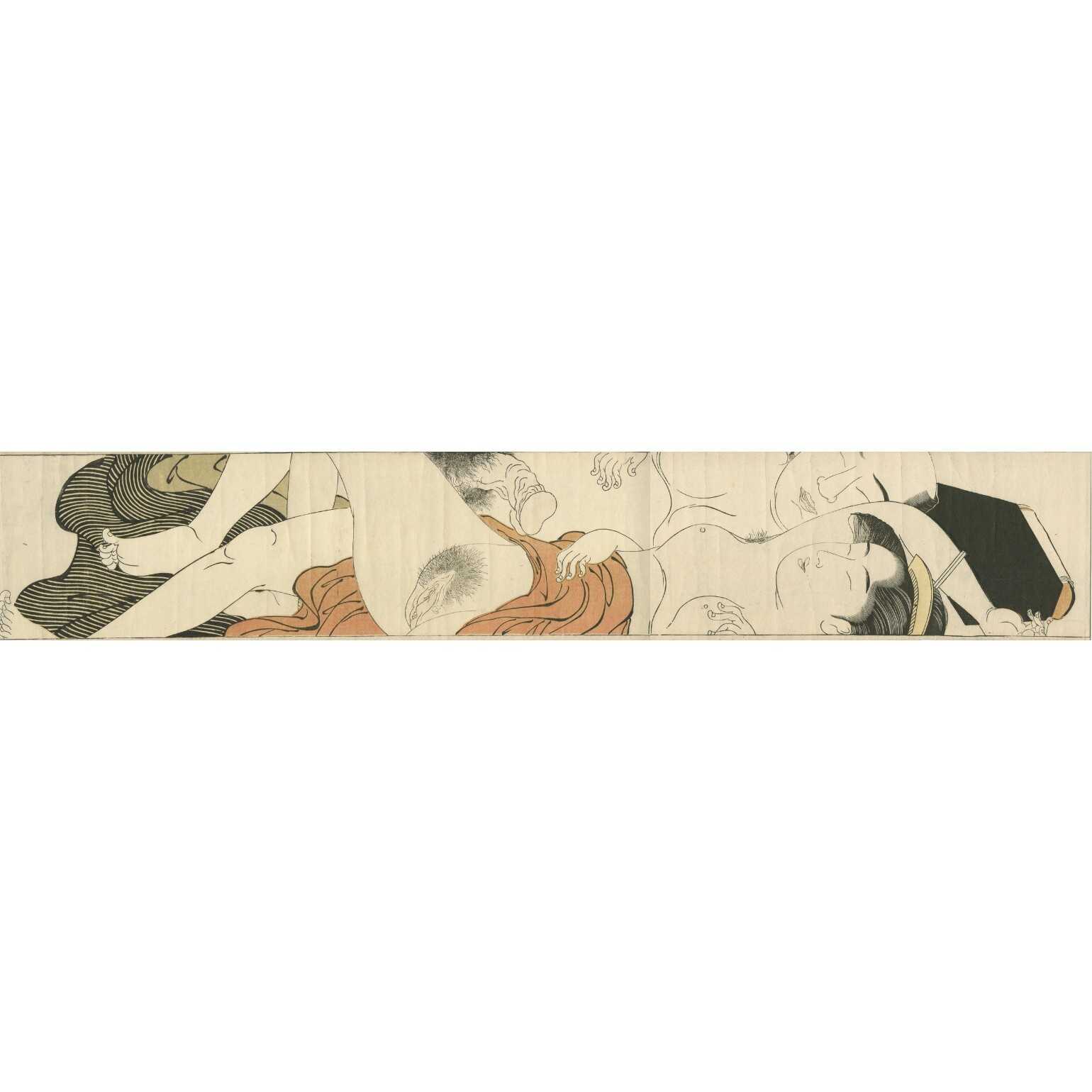
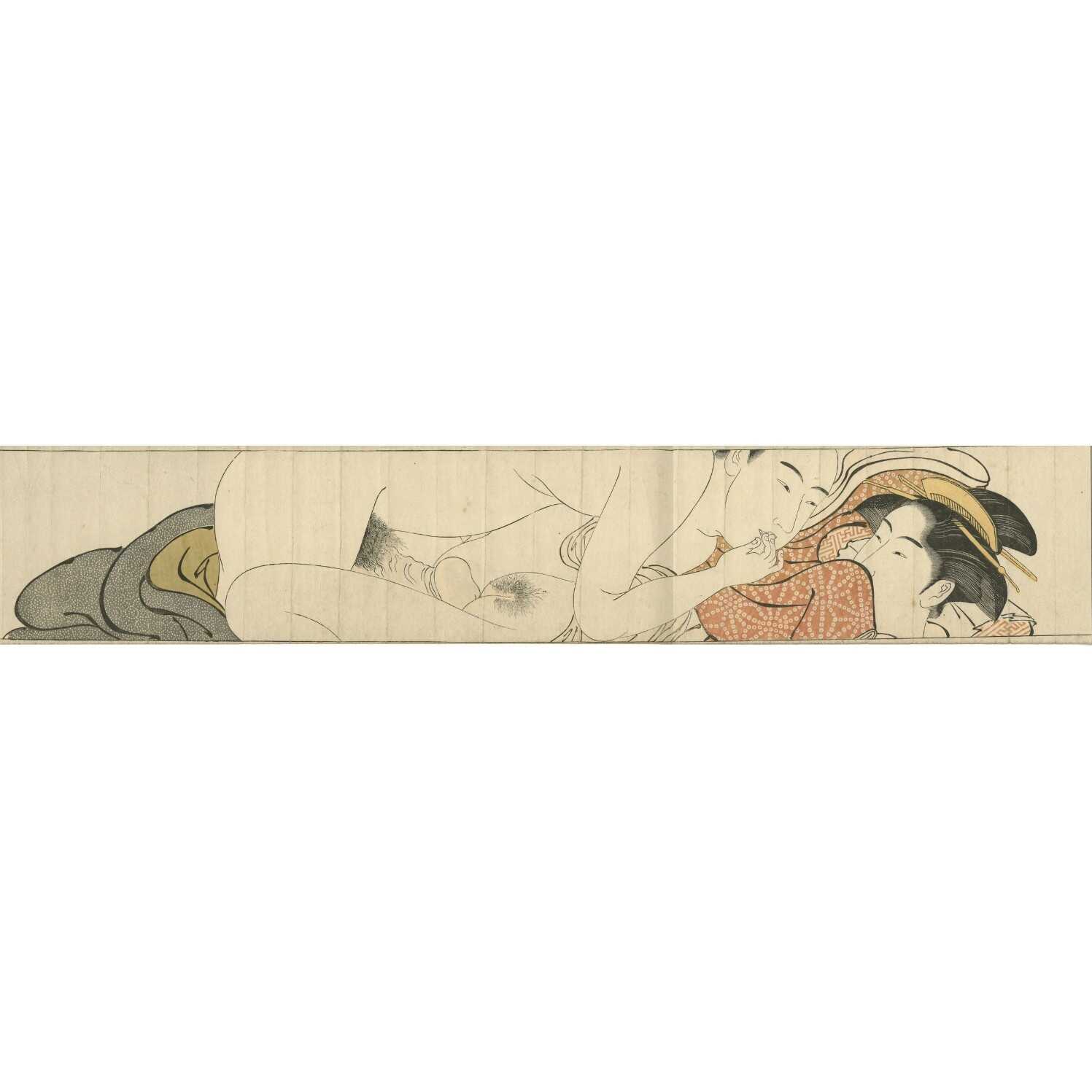
These three non-sequential sheets come from Handscroll for the Sleeve (Sode no maki, 袖の巻), an erotic makimono (巻物) attributed to Torii Kiyonaga. The complete set consists of eleven scenes of sexual coupling, followed by a twelfth sheet depicting close-up images of female genitalia. Each composition is rendered in a long, narrow horizontal format, with cropped figures and flowing lines emphasising physical intimacy and visual rhythm.
The title alludes to a poetic metaphor likening a woman’s beauty to “a handscroll tucked into the sleeve,” suggesting sensuality, discretion, and portability. Erotic scrolls of this type were known as shūchin (袖珍, “sleeve treasures”) and were often hidden within the folds of a kosode kimono (小袖) or kept in small bedside drawers.
Rather than presenting eroticism as purely physical, the imagery incorporates classical allusions that elevate desire as a universal force. References to the divine union of Izanagi and Izanami (伊邪那岐・伊邪那美), the longing of Emperor Wu Di (武帝) for Lady Li, and the evocative phrase “a fluttering sleeve” position shunga as a restorative, even poetic, experience. The charm of a woman is likened to a plum blossom at the window — intimate, fleeting, and emotionally resonant.
Handscroll for the Sleeve is widely considered a masterpiece of the shunga tradition, admired for its formal elegance, psychological subtlety, and the refined sensuality of Kiyonaga’s line.
№ 6 (125 x 660 mm): "The woman's blackened teeth indicate that she is a wife. This middle-aged couple is relaxing and drowsing after lovemaking. The scene is peaceful now, but the pillow cast aside hints at their earlier, passionate lovemaking."

№ 9 (125 x 680 mm): "This looks to be the first sexual experience of a young woman of a well-to-do family, who covers her mouth shyly. The more experienced man moistens his fingers with saliva, eager to explore the young woman's body".

№ 11 (125 x 700 mm): "The woman wears a so-called Iwata sash, signalling that she is pregnant. The man approaches from behind so as not to put pressure on her stomach. He shows care and gentle consideration toward his pregnant wife, who appears relaxed."

Captions cited from Shunga: Sex and Pleasure (Timothy Clark et al.)
References:
[LIB-1474.2018] Important Japanese prints from the collection of Henry Steiner. Catalogue № 14. — NY: Sebastian Izzard LLC, 2018; pp. 36-7.
[LIB-1473.2014] Shunga: Sex and pleasure in Japanese art / Edited by Timothy Clark, et al. — London: British Museum Press; Amsterdam: Hotei Publishing, 2013; pp. 182-9.
[LIB-2971.2022] Chris Uhlenbeck, Margarita Winkel. Japanese erotic fantasies: sexual imagery of the Edo period. — Amsterdam: Hotei Publishing, 2005; pp. 118-9.
Additional Information
| Collection | Erotica , Japanese prints and drawings |
|---|---|
| Type / Purpose | Fine art , Woodblock print |
| Period | 18 AD , Edo period [江戸時代] (1603–1868) , Late 18th century , Tenmei era [天明] (1781–1789) |
| Country | Japan |
| Media/Technique | Ink and color on paper , Woodblock print (nishiki-e) |
| Size | Makimono |
| Subject | Erotica , Love , Man , Scrolls , Sex , Sexual life , Sexuality , Shunga , Woman |
| Series | Sode no maki (Handscroll for the Sleeve) |
| Creation / Publishing year | 1785 |
| Acquisition year | 2013 |


