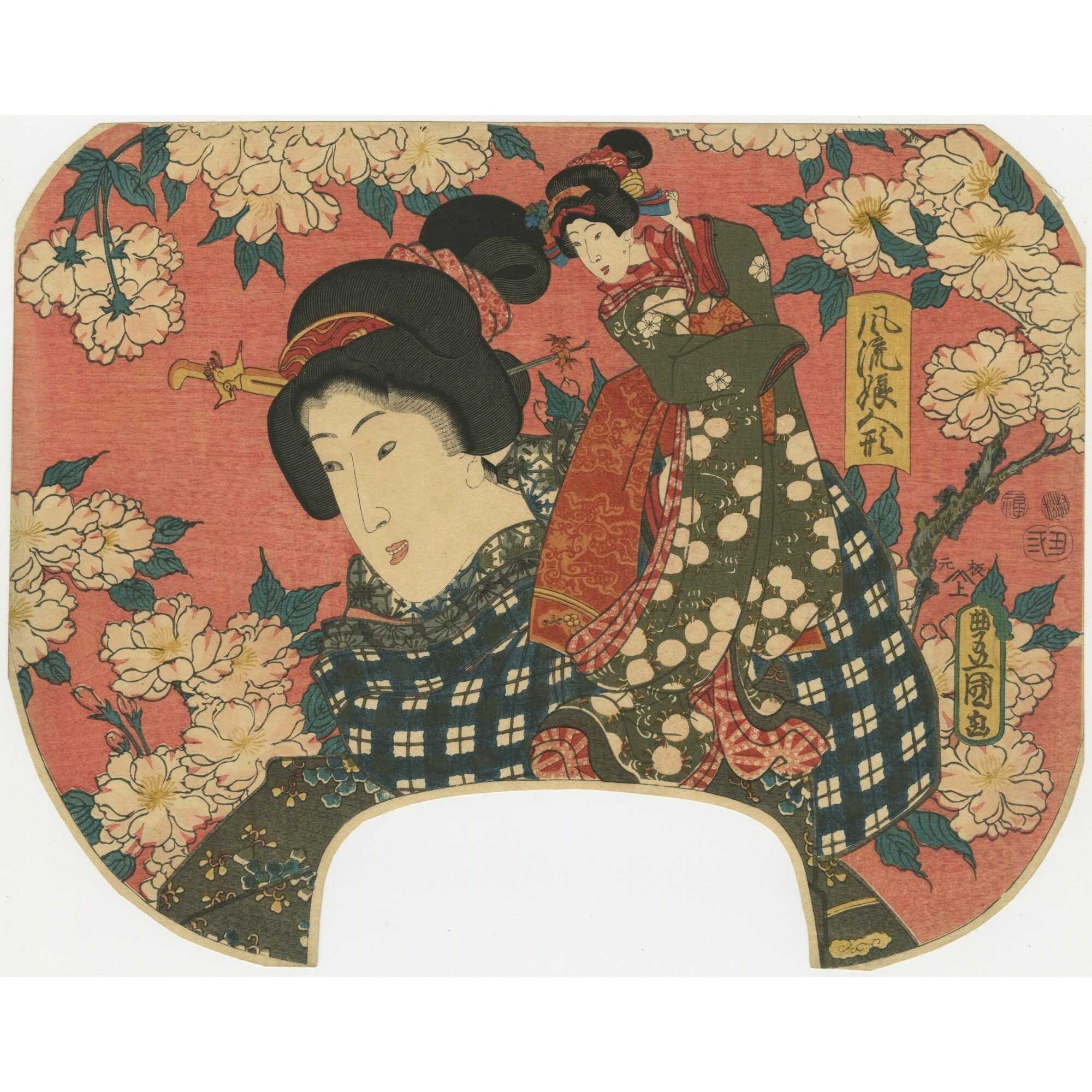
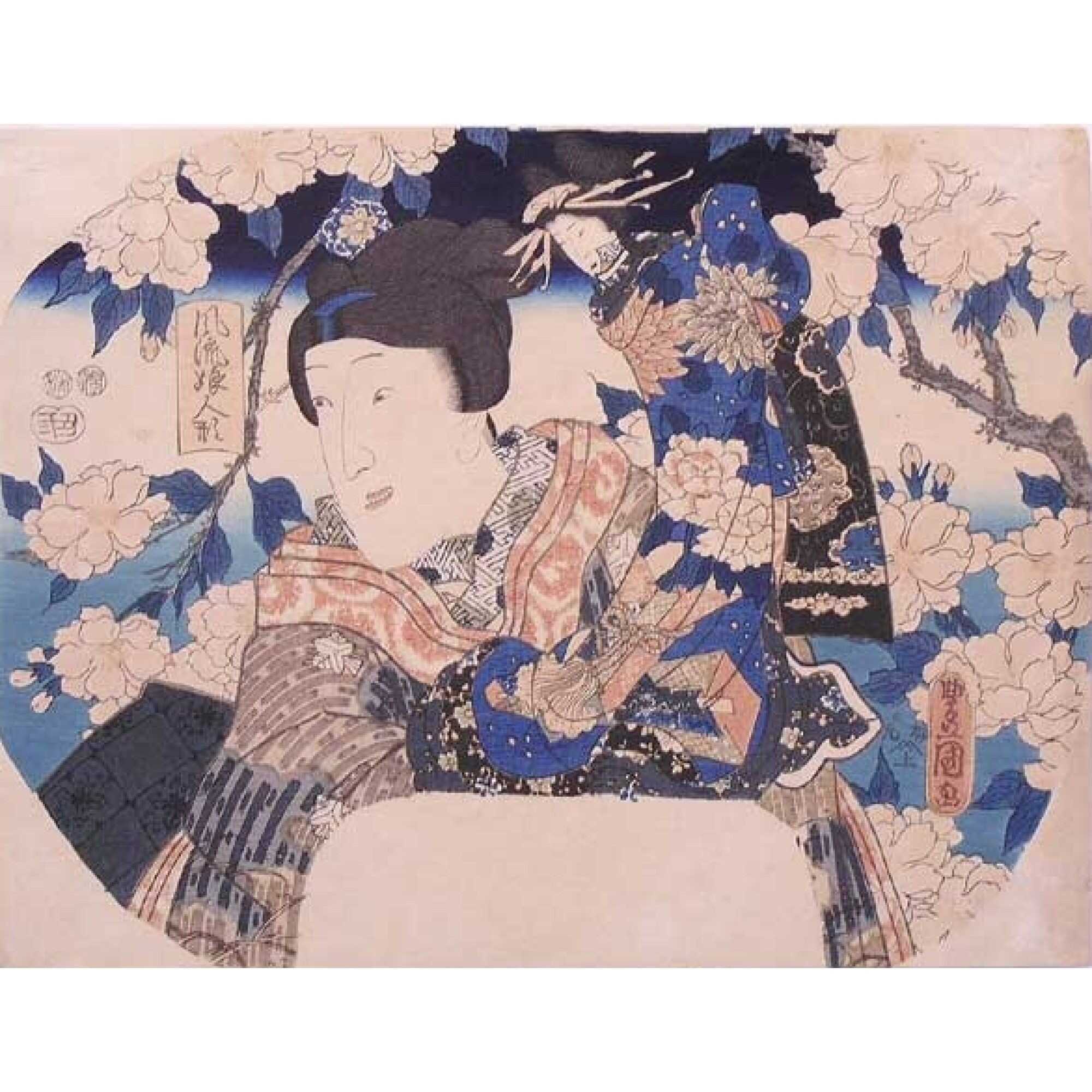
Description: Half-length composition of a young woman set against a pink ground and framed by flowering peonies (botan, 牡丹). According to Horst Graebner (Kunisada Project), the figure may be understood as a bijin transposition of a kabuki actor; she turns her head to the left while raising in her right hand a small puppet figure of another kabuki actor in role, though the identification of both actors and the role remains uncertain. Her coiffure is adorned with a tortoiseshell kanzashi (鼈甲簪) with a crane motif (tsuru, 鶴), paired with a hirauchi kanzashi (平打簪) decorated with sparrow and bamboo (suzume–take, 雀竹). The layered kimono combines bold geometric checks with floral motifs, while the puppet wears a green robe patterned with plum and cherry blossoms in a flowing stream and a red obi with celestial clouds.
The series employs a mitate device that transposes kabuki imagery into the sphere of bijin representation. The present sheet depicts a Kyōto doll (Kyō ningyō, 京人形)
Puppetry in Japan, introduced from China via Korea by the ninth century, included early hand puppets (tezuma) used by itinerant performers who carried their figures in portable boxes that doubled as stages (Baten, Lea. Playthings and Pastimes in Japanese Prints. — New York: Weatherhill, 1995) [LIB-3434.2025].
An oyama ningyō (女形人形) is a term used to describe female-looking dolls that actually represent male actors in women’s roles (onnagata) (Coats, Bruce A. Chikanobu: Modernity and Nostalgia in Japanese Prints. — Leiden: Hotei Publishing, 2006) [LIB-3045.2022].
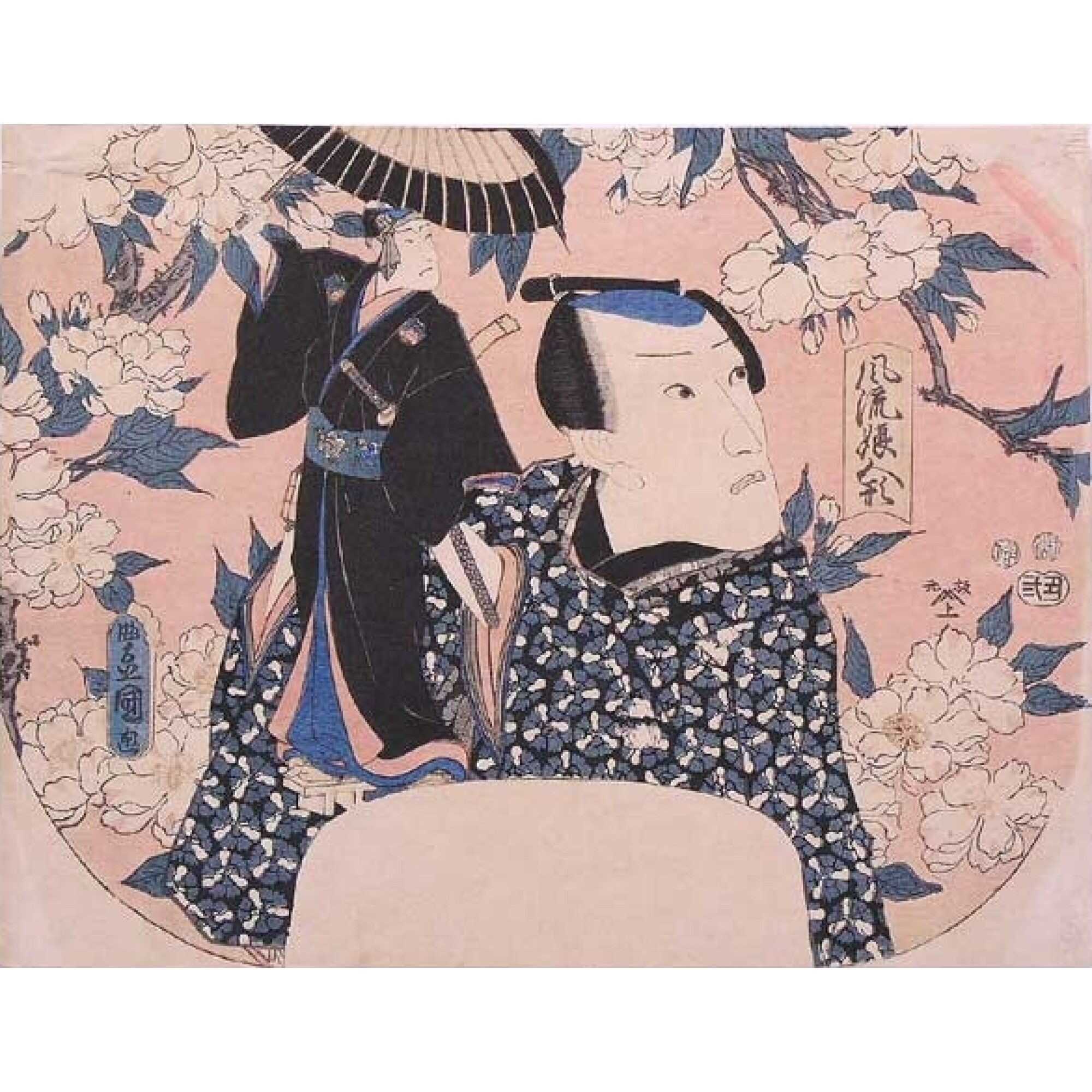
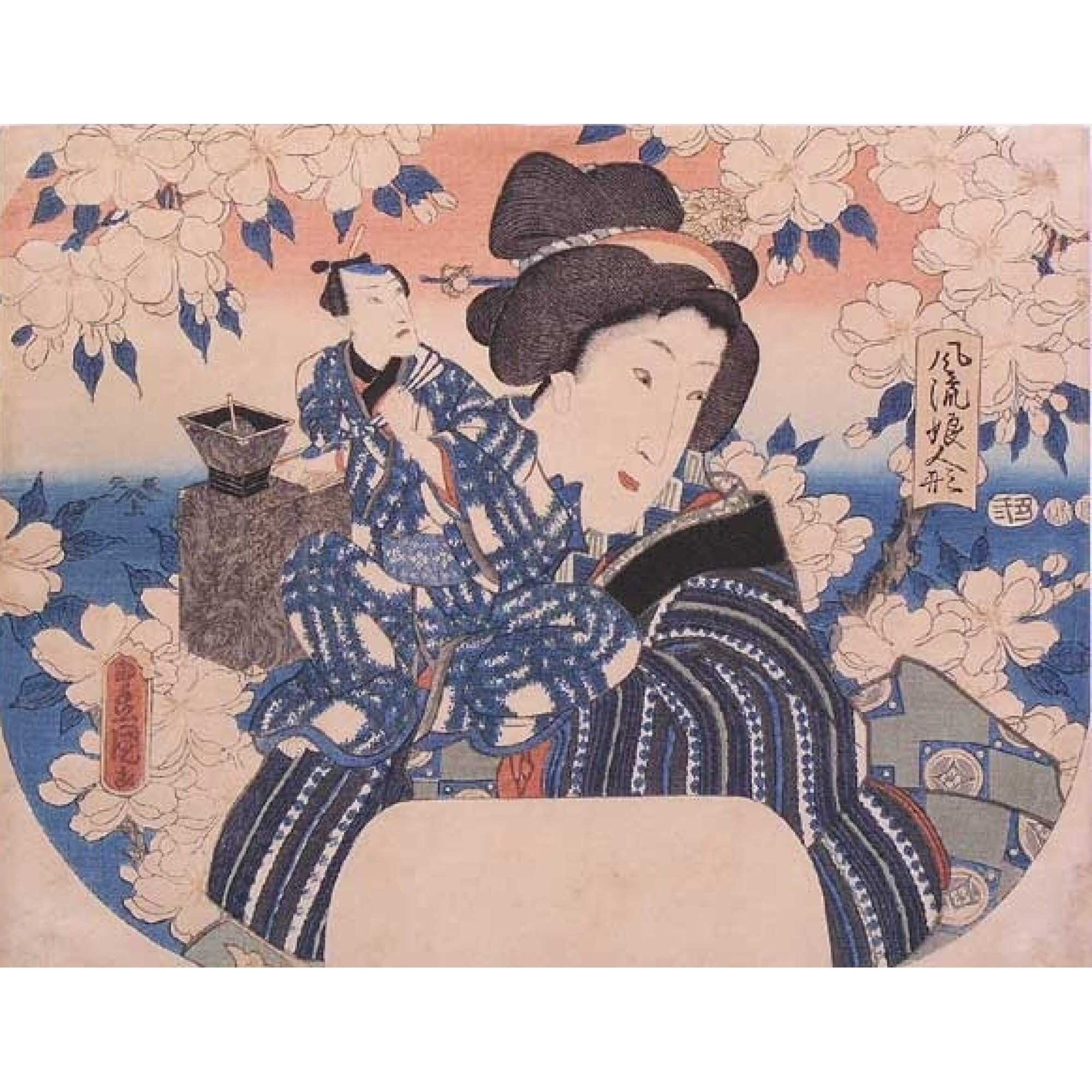
Note: Three further fan prints from the same series are recorded in the Kunisada Project database:
ka14581: Ichikawa Danjūrō VIII with Sukeroku puppet
ka14582: unidentified actor with puppet
ka14583: Ichimura Uzaemon XIII (?) with Agemaki puppet
Condition: backed; cut to fan shape (uchiwa-e), with loss of original margins as issued for mounting.