
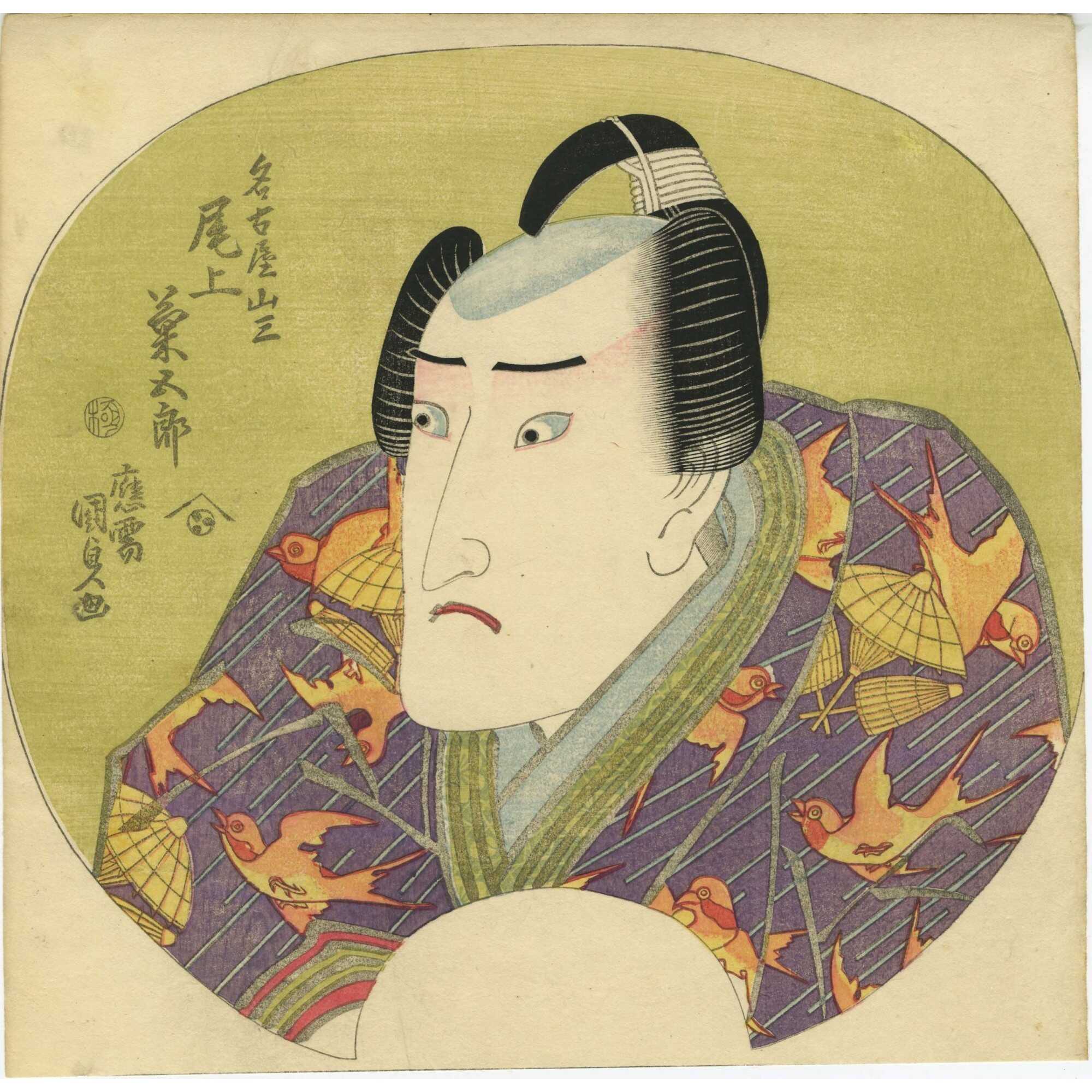
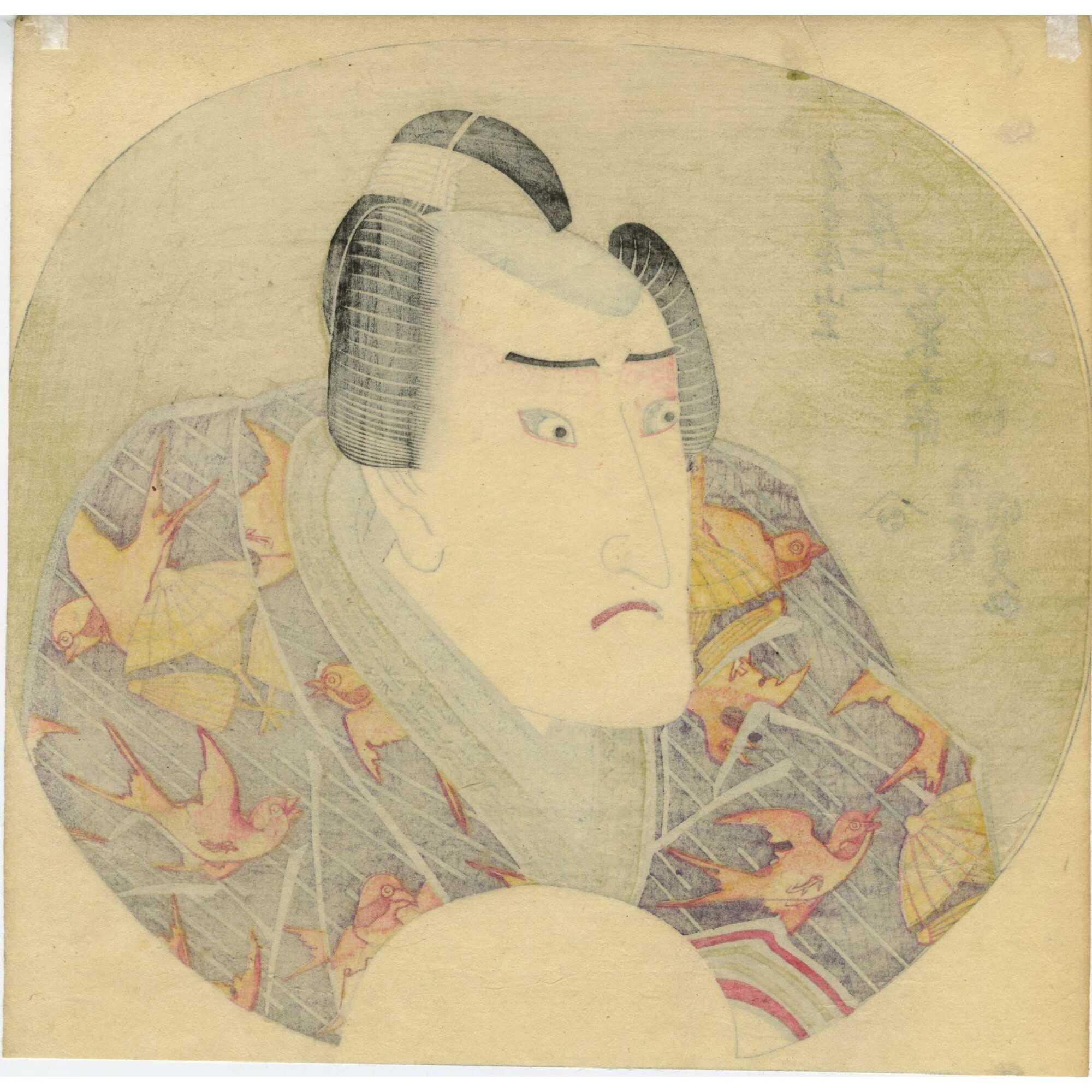
Artist: Utagawa Kunisada [歌川 国貞], a.k.a. Utagawa Toyokuni III [三代 歌川 豊国] (Japanese, 1786 – 1865).
Signed: ōju Kunisada ga (應需國貞画) – "Drawn by Kunisada on commission"
Date: No date
Censor seal: kiwame (極)
Publisher: Nishimuraya Yohachi [西村屋与八] (enterprise, op. c. 1751 – 1860); Marks: 01-008 | 391a
Media: Aiban yoko-e uchiwa-e (団扇絵), color woodblock print, 225 x 292 mm.
Kabuki Actor: Onoe Kikugorō III [尾上菊五郎] (Japanese, 1784 – 1849); other names: Ōkawa Hashizō I, Onoe Baikō III, Onoe Matsusuke II, Onoe Eizaburō I
Role: Nagoya Sanza (名古屋山三)
A half-length portrait of Onoe Kikugorō III (尾上菊五郎) in the role of Nagoya Sanza (名古屋山三), depicted in a three-quarter view, turned slightly to the right. His chonmage (丁髷) hairstyle, with a neatly tied topknot and wrapped hair cords, reflects his status as a samurai.
He wears a purple kimono decorated with swallows (燕, tsubame), bamboo umbrellas (唐傘, karakasa), and streaks of rain—a dynamic and symbolic pattern. Swallows are often associated with change, travel, and perseverance; the umbrellas and rain may evoke a sense of wandering and hardship, themes relevant to the character of Nagoya Sanza, a disgraced samurai seeking revenge. The inner collar features green and gold-striped layers, contrasting the outer robe.
The background is a muted yellow-green monochrome, highlighting the rich details of the actor’s costume and facial expression. To the left of the figure, the inscriptions identify the character’s name (名古屋山三, Nagoya Sanza) and the actor (尾上菊五郎, Onoe Kikugorō III). The artist’s signature, 應需國貞画 (Ōju Kunisada ga), appears in the lower left, indicating that the print was created on commission.
This uchiwa-e likely dates to the late Bunsei era (c. 1820s–1830s). Onoe Kikugorō III played this role in 1823, 1827, 1831, and 1836, with the closest match in kimono design traced to 1827. That year, the play Ōichiza Soga no shimadai (群曽我島台) was staged at Kawarazaki-za in the 1st lunar month, suggesting this print may be associated with that performance.
 |
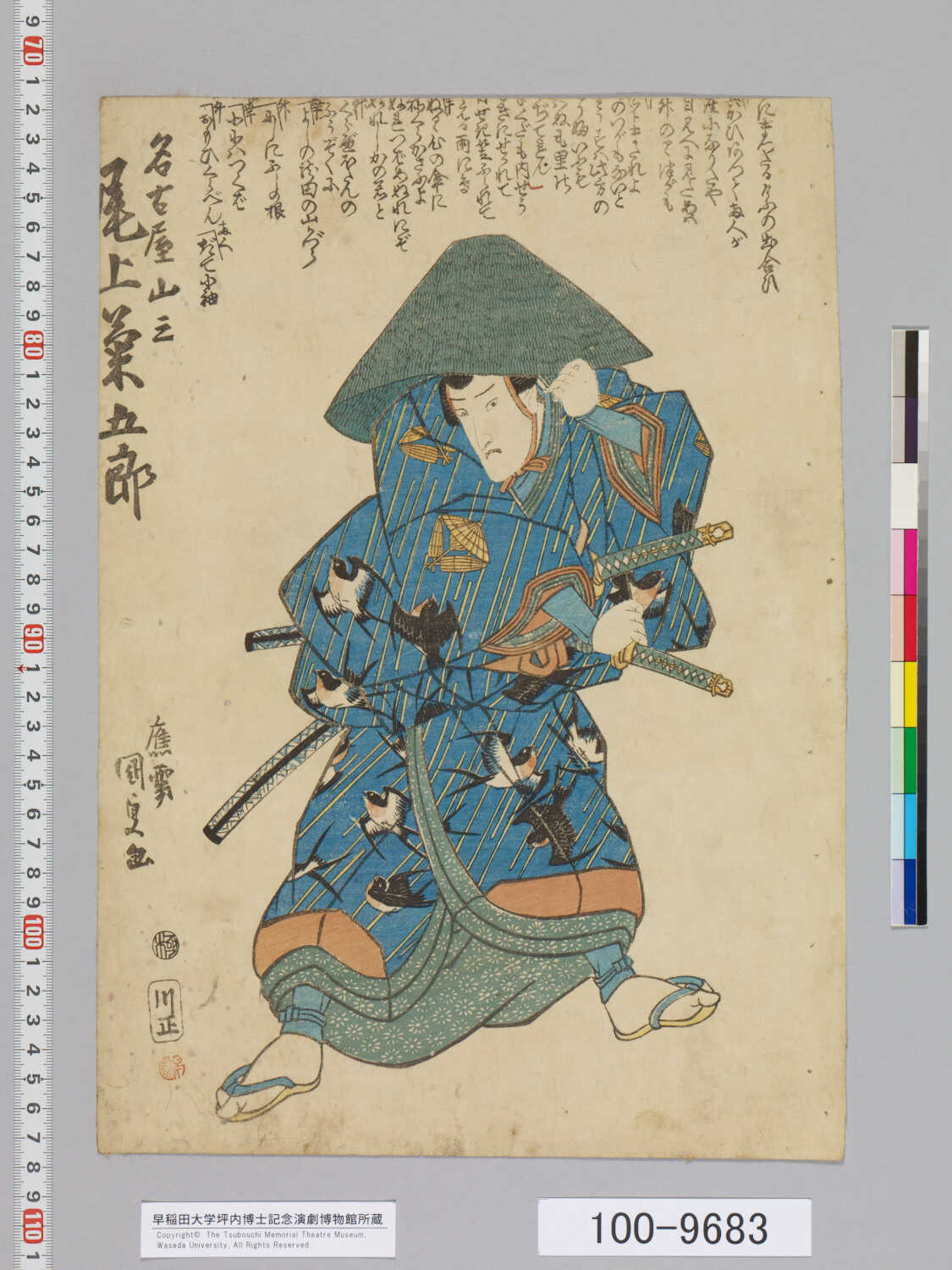 |
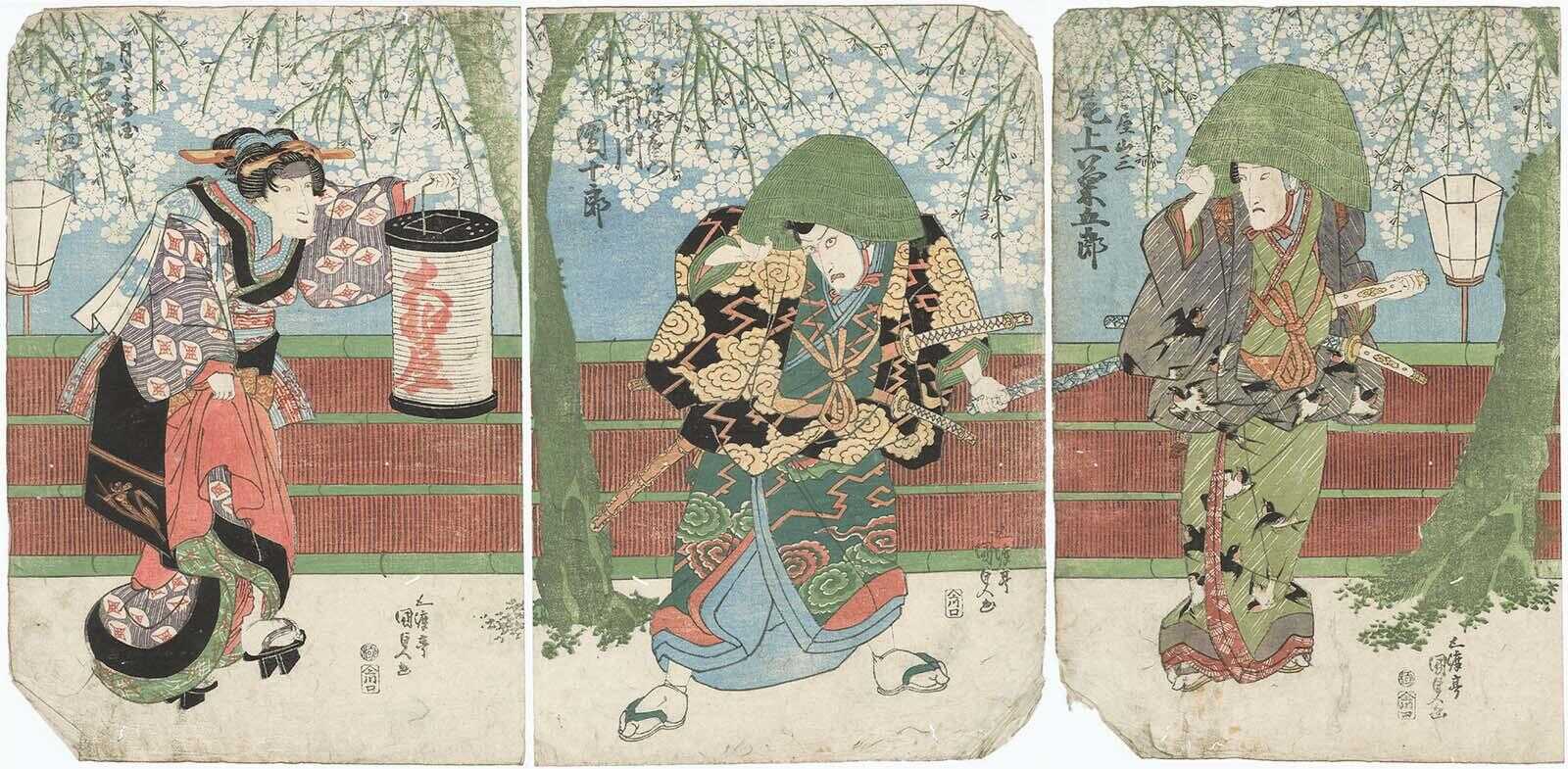
| MFA Accession Number 11.43447a-c | Waseda 100-9683 |
Nagoya Sanza (名古屋山三) is a legendary samurai and a central figure in the classic kabuki and bunraku play Meiboku Sendai Hagi (伽羅先代萩). His story is rooted in historical events from the Date clan of Sendai, although it has been highly dramatized in Edo-period theatre.
Sanza is a loyal retainer falsely accused of stealing a valuable sword and subsequently banished. Stripped of his honour, he takes on the appearance of a wandering samurai dressed in a distinct kimono with a cloud and dragonfly pattern. Meanwhile, his rival, Fuwa Banzaemon (不破伴左衛門), flaunts the stolen sword and openly taunts him. Their encounters, particularly the famous rainy night duel scene, are among kabuki's most visually striking moments. Sanza’s story is of perseverance and revenge, as he ultimately seeks to restore his name and expose the true culprit behind the theft.
[Thanks to Horst Graebner of Kunisada Project]
Additional Information
| Collection | Fan print (Uchiwa-e) [団扇絵] , Japanese prints and drawings |
|---|---|
| Type / Purpose | Fan , Woodblock print |
| Period | 19 AD , Bunsei era [文政] (1818–1830) , Edo period [江戸時代] (1603–1868) , Mid-19th century |
| Country | Japan |
| Media/Technique | Ink and color on paper , Woodblock print (nishiki-e) |
| Subject | Actor print , Fan , Fan print , Kabuki , Kabuki actor , Kabuki actors , Nagoya Sanza [名古屋山三] , Portrait , Uchiwa-e |
| Creation / Publishing year | 1820s , 1830s |
| Size | Aiban yoko-e uchiwa-e , Fan print. Uchiwa-e |
| Genre | Actor Prints (Yakusha-e, 役者絵) |
| Acquisition year | 2025 |
Related Items


