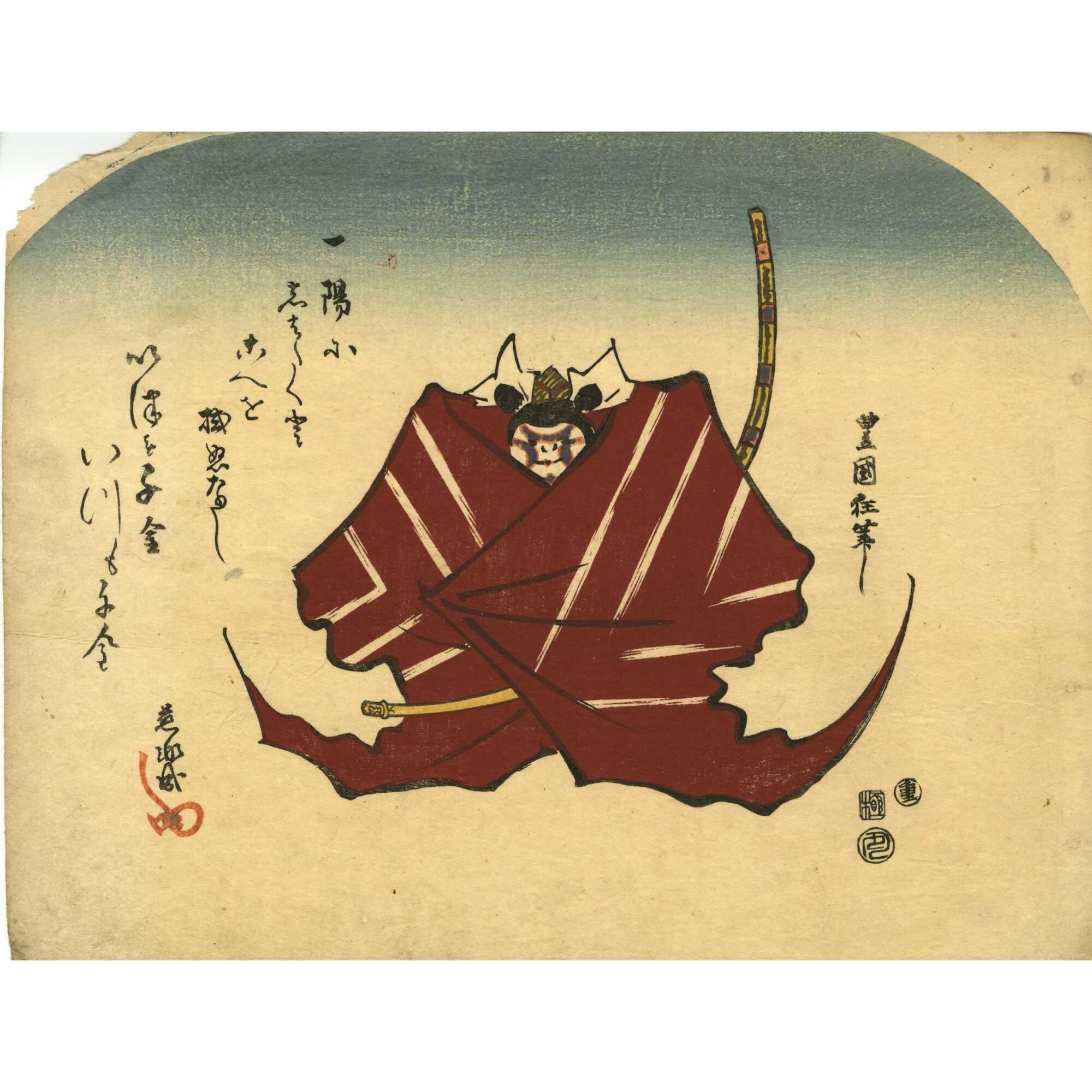
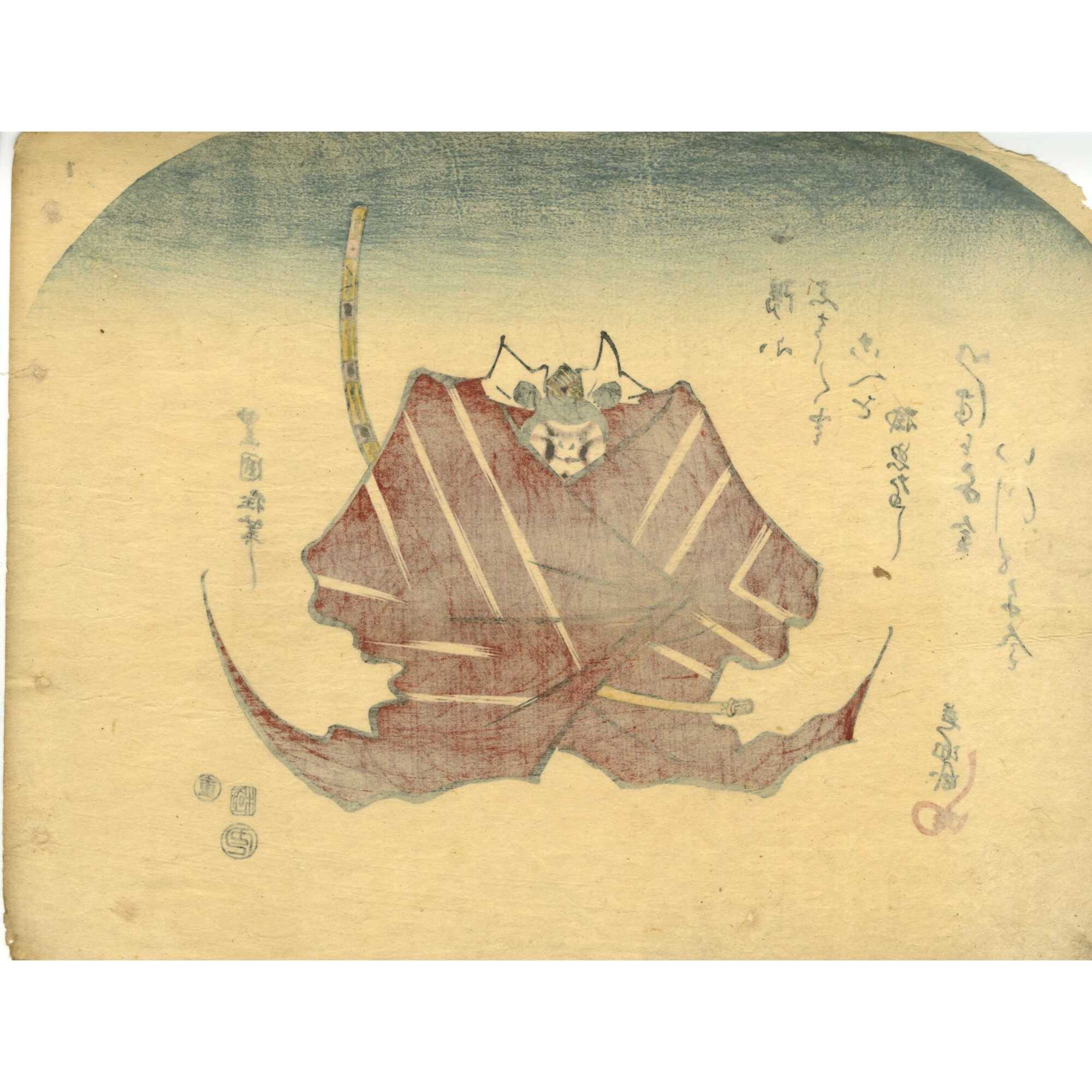
Utagawa Toyokuni II (a.k.a. Toyoshige ). Ichikawa Danjūrō VII as a Bat in a Shibaraku Role / Fan print, 1829.
Character/Sitter
Ichikawa Danjūrō VII [Ichikawa Ebizō V; Ichikawa Shinnosuke I] (Japanese, actor, 1791–1859)

Ichikawa Danjūrō VII [Ichikawa Ebizō V; Ichikawa Shinnosuke I] (Japanese, actor, 1791–1859)
Artist: Utagawa Toyokuni II [歌川豊国二代] a.k.a. Toyoshige [豊重] (Japanese, (1777 – 1835)
Signed: 豊国狂筆 (Toyokuni kyō-hitsu, "mad brush of Toyokuni")
Publisher: Maru-Jū (丸重), seal Jū (重), Marks reference 08-079 | U190a (1826–1829, only on fan prints)
Censor Seal: Kiwame + Bunsei 12, Year of the Ox (丑), 1829
Media: Uchiwa-e (fan print), color woodblock print, 231 x 297 mm
Provenance: Nelkin Collection
Full-body, frontal view of Ichikawa Danjūrō VII, abstractly depicted as a bat, with only his head, topknot, and white collar emerging from the upper centre of a voluminous, stylized red cloak. The cloak is sharply angular and wing-shaped, evoking a bat in flight, while also suggesting the kanji character 市 (ichi) — the first character of Ichikawa (市川) — making the figure a visual pun on the actor’s name.
The cloak is rendered in a saturated reddish-brown colour known as shū-iro (赭色) or tan-red, a bold and dramatic hue traditionally associated with the Shibaraku role. This distinctive costume — known as the sugata no iro (姿の色) — was used to signal heroic power, dominance, and theatrical presence. The white stripes across the cloak allude to the Ichikawa family crest (三升, mitsumasu) — three nested rice-measuring boxes — an emblem long associated with the Danjūrō lineage.
Tucked at the waist and partially emerging from beneath the cloak is a massive stylized sword — a visual exaggeration of the ōdachi (大太刀) worn in the Shibaraku role. Such a sword is not functional but a key prop in aragoto-style performance, symbolizing exaggerated strength and heroic resolve.
Danjūrō’s face is adorned with the iconic kumadori (隈取) makeup — deep red lines accentuating his brow and cheeks — a hallmark of aragoto roles and especially of Shibaraku, where the protagonist enters with a thunderous call and righteous fury.
To the upper right is the signature 豊国狂筆 (Toyokuni kyō-hitsu) – "the mad brush of Toyokuni", used here by Utagawa Toyokuni II. The kiwame (極) censorship seal and a date seal appear in the lower right. To the left is a vertical kyōka poem, followed by the actor’s name and a red double gourd (ひさご, hisago) — another signature emblem of Danjūrō VII.
This print is not a literal depiction of a scene from Shibaraku but a bold emblematic portrait, condensing multiple aspects of Danjūrō VII’s iconic identity: his name, crest, theatrical role, and stage persona — all rendered in a single symbolic form.
| Collection | Fan print (Uchiwa-e) [団扇絵] , Japanese prints and drawings |
|---|---|
| Type / Purpose | Fan , Woodblock print |
| Period | 19 AD , Bunsei era [文政] (1818–1830) , Early 19th century , Edo period [江戸時代] (1603–1868) |
| Country | Japan |
| Media/Technique | Ink and color on paper , Woodblock print (nishiki-e) |
| Size | Aiban yoko-e uchiwa-e , Fan print. Uchiwa-e |
| Subject | Actor print , Anthropomorphic animals , Bat (komori) , Ichikawa Danjūrō VII [Ichikawa Ebizō V, Ichikawa Shinnosuke I] (Japanese, 1791 – 1859) , Kabuki , Kabuki actor , Kabuki actors , Kabuki theater , Shibaraku , Theatre , Uchiwa-e |
| School | Utagawa (歌川) |
| Creation / Publishing year | 1829 , Bunsei 12 |
| Genre | Actor Prints (Yakusha-e, 役者絵) |
| Acquisition year | 2025 |


