
![Isoda Koryūsai . Prosperous Flowers of the Elegant Twelve Seasons: young couple making love while older man sleeps. [Shunga]. 1773](/media/uploads/svjp200039.2015-web-scaled-1.jpg)
Artist: Isoda Koryūsai [礒田湖龍斎] (Japanese, 1735–1790)
Signed: Unsigned
Series: Fūryū jūniki no eika (風流十二気の栄花, Prosperous Flowers of the Elegant Twelve Seasons)
Date: c. 1772–1773 (An’ei 1–2)
Publisher: Unknown
Media: Woodblock print (nishiki-e), ink and color on paper; Chūban orihon (中判折本), folded album; 174 × 243 mm
Genre: Shunga (erotic print)
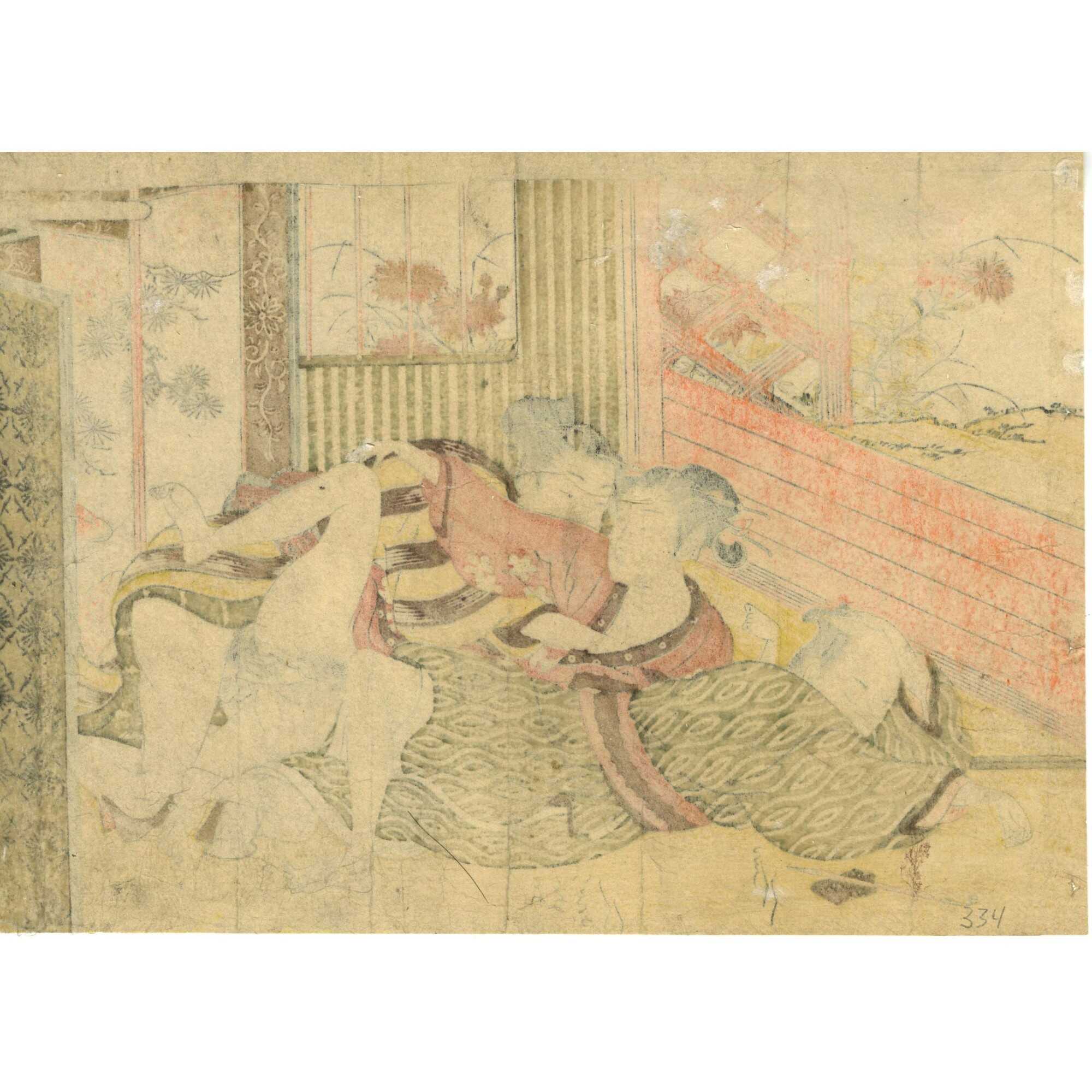
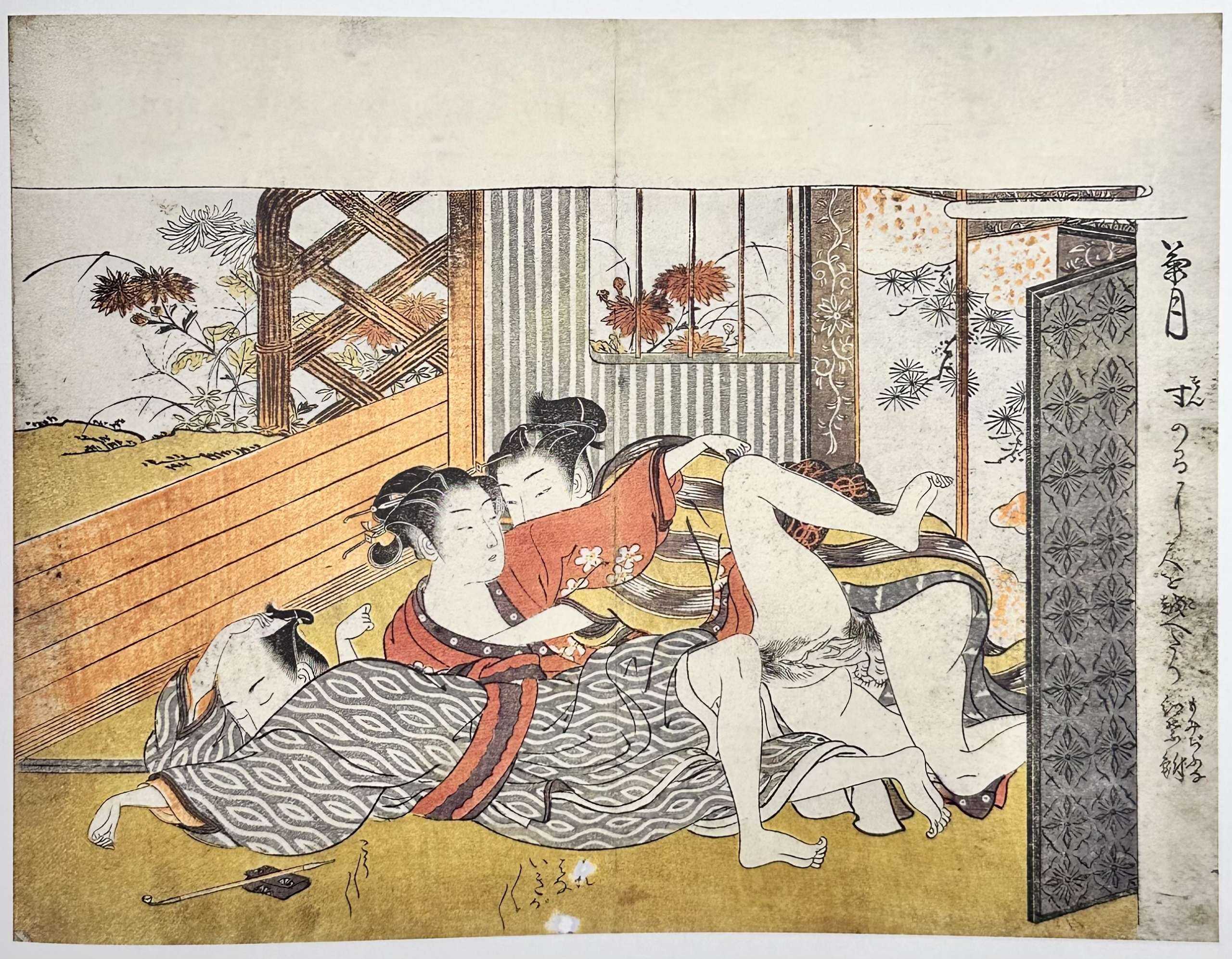
One of twelve prints from the album Fūryū jūniki no eika (Prosperous Flowers of the Elegant Twelve Seasons, 風流十二気の栄花) by Isoda Koryūsai, this image depicts a clandestine erotic encounter between a young couple and an older man. The wakashu (若衆) straddles the woman from behind, partially cloaked in a yellow and purple striped kimono. Her red robe, patterned with plum blossoms (ume, 梅), falls open to reveal her legs and genitals. To the left — immediately in front of the woman — an older man (possibly her husband) lies asleep, one arm tucked beneath his head, the other resting on his shaved crown. A discarded pipe (kiseru, 煙管) and tobacco pouch lie beside him.
Chrysanthemums (菊) bloom in the garden beyond a bamboo lattice, with more visible behind the window, evoking the ninth lunar month, Kikuzuki (菊月, “Chrysanthemum Month”). The interior is partitioned by a folding screen decorated with pines and stylized clouds. The original, uncut impression includes a vertical inscription in flowing script at the right, now trimmed in the present copy.
At the lower margin appears the phrase:
寸の間に尺を越たり
Sun no ma ni shaku o koetari
“Small is better than big”
This humorous line likely refers to the contrast between the young boy’s modest penis and the assumed larger one of the sleeping elder — a common shunga motif in which youthful vigor is preferred over size. A further pun appears in momijibuna (紅葉鮒), a seasonal term for the crucian carp (buna), prized for its flavor and smallness. The word links autumn leaves (momiji, 紅葉) and sexual desirability, reinforcing the print’s layered theme: in fish, in lovers — “the smaller, the better.”
This composition exemplifies Koryūsai’s refined blend of eroticism, humor, and seasonal reference. As part of a structured twelve-month cycle, it combines poetic wordplay, visual intimacy, and social nuance within the compact chūban format.
Reference:
[LIB-3442.2025] Highlights of Japanese printmaking. Part 4: Shunga. — NY: Scholten Japanese Art, 2014; pp. 34-8.
[LIB-1491.2018] Inge Klompmakers. Japanese erotic prints: Shunga by Harunobu and Koryūsai. — Leiden & Boston: Hotei publishing, 2008; p. 113.
Additional Information
| Collection | Erotica , Japanese prints and drawings |
|---|---|
| Type / Purpose | Woodblock print , Woodblock print album |
| Period | 18 AD , An’ei era [安永] (1772–1781) , Edo period [江戸時代] (1603–1868) , Late 18th century |
| Country | Japan |
| Media/Technique | Ink and color on paper , Woodblock print (nishiki-e) |
| Size | Chūban orihon , Horizontal chuban |
| Subject | Erotica , Japan , Japanese woodblock prints , Sex , Sexual behavior and attitudes , Sexual life , Sexuality , Shunga |
| Series | Fūryū jūniki no eika (Prosperous Flowers of the Elegant Twelve Seasons) |
| Creation / Publishing year | 1772 , 1773 |
| Acquisition year | 2015 |


