
Artist: Isoda Koryūsai [礒田湖龍斎] (Japanese, 1735–1790)
Ehon: Enshoku Hō ya Hō (艶色宝屋宝, Sensual Colours: A Phoenix Released in a Field)
Date: c. 1775–1776 (An’ei 5)
Format: Yoko-ōban (横大判), deluxe horizontal print, likely issued as a loose sheet or folded album page; 240 × 373 mm (backed)
Medium: Woodblock print (nishiki-e), ink and colour on paper
Publisher: Unknown
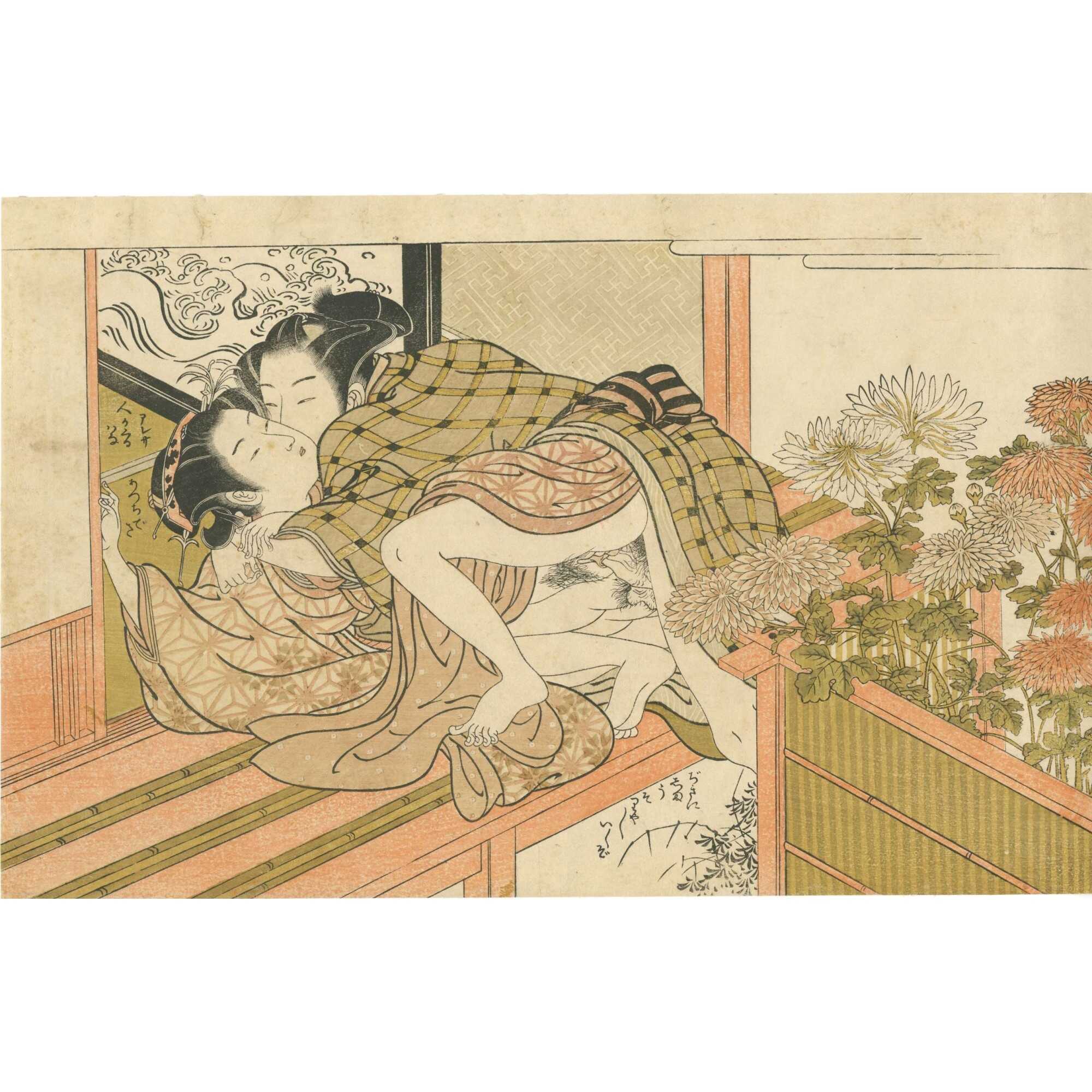
A young couple embraces on a wooden veranda, surrounded by blossoming chrysanthemums. The male figure is depicted as a wakashu (若衆), identifiable by his partially shaved head and forward lock (maegami, 前髪), indicating adolescent status. He is dressed in a yellow-and-green checked haori, and presses closely against the woman, whose body twists toward him with her kimono slipping open. Their union is framed by the elegant autumn flora, rendered in soft orange, white, and ochre tones, with chrysanthemums signifying both seasonal beauty and erotic symbolism. A folding screen decorated with stylized waves anchors the interior, while the open terrace and garden suggest intimacy on the edge of exposure.
Dialogue:
— She: 「アレサ 人かくるはな あつちでさ」 Aresa, hito ga kuru wa na. Acchi de sa. “Hey—someone’s coming, let’s go over there.”
— He:「ぢきにしまう そりゃ/\ いくぞ」 Jiki ni shimau. Sorya, sorya, iku zo. “It’ll be over soon—alright, alright, I’m going in!”
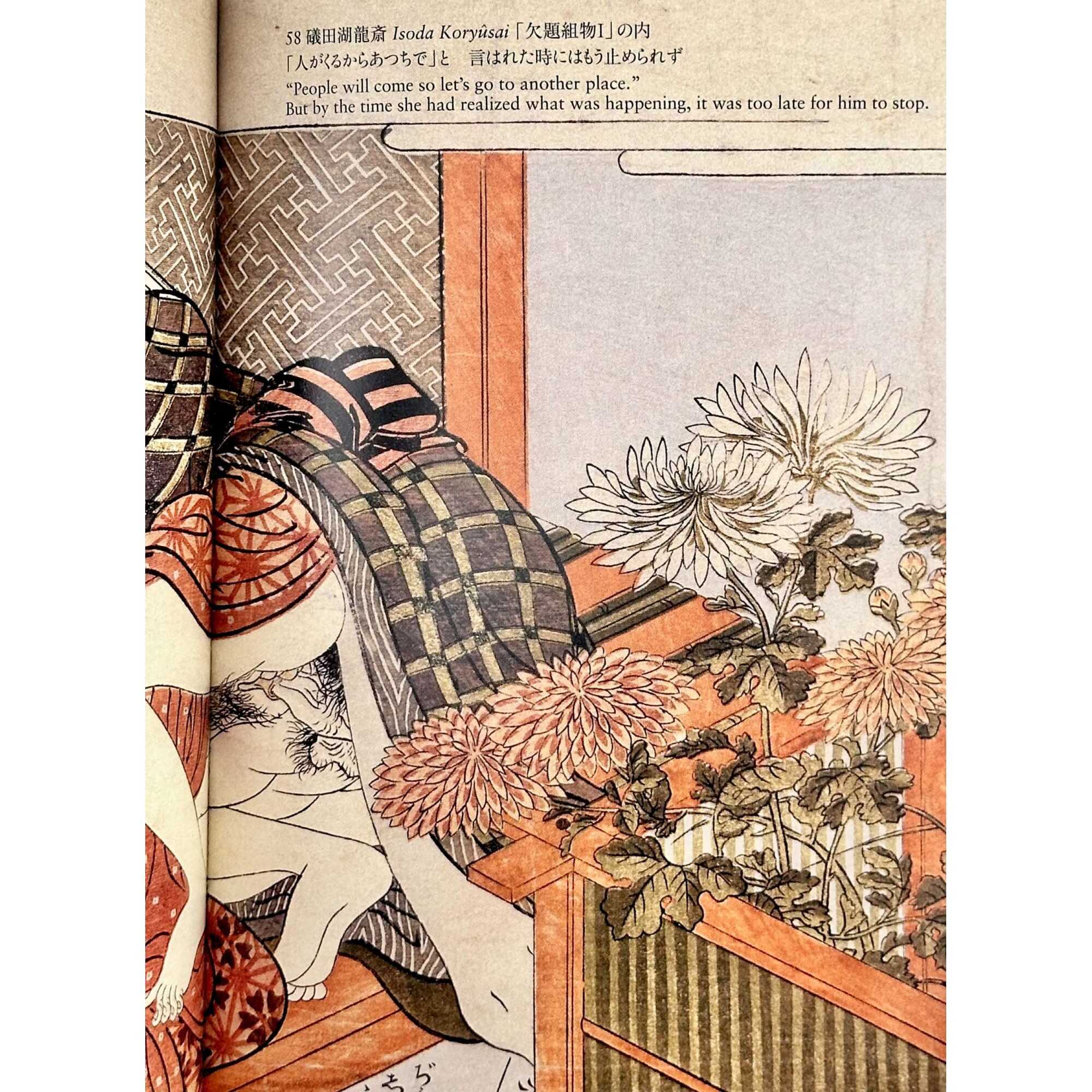
…But by the time she had realized what was happening, it was too late for him to stop.
Reference:
(1) [LIB-3440.2025] Hayakawa Monta, Shirakura Yoshihiko. Shunga: Japanese Erotic Art. — Tokyo: PIE Books, 2009, pl. 58.
(2) [LIB-3468.2025] Jack Hillier. The Art of the Japanese Book. — London: Sotheby’s Publications, 1987; pp. 365-6, Plate 48:
Lovers on a verandah. From picture book Enshoku Hō ya Hō (艶色宝屋宝, Sensual Colours: A Phoenix Released in a Field), c. mid-1770s. The picture of the lovers on a verandah beyond chrysanthemums growing in the garden, from one of these large-scale albums is a wonderful composition, the entangled limbs, the rippling patterns of the clothes, the feathery forms of the blooms, weave around the rigid verticals and diagonals of the framework of the house, the engawa (縁側) and the garden fence. …The women’s coiffure is in the transitional stage of 1775/6, between the drawn-back fashion of Harunobu’s time and the full-blown torobin (とろびん) of about the late 1770s.
Additional Information
| Collection | Erotica , Japanese prints and drawings |
|---|---|
| Type / Purpose | Book illustration , Woodblock print |
| Period | 18 AD , An’ei era [安永] (1772–1781) , Edo period [江戸時代] (1603–1868) , Late 18th century |
| Country | Japan |
| Media/Technique | Colour , Ink , Paper , Woodblock print , Woodblock print (nishiki-e) |
| Size | Yoko-ōban |
| Subject | 18th century , Book illustration , Erotica , Japan , Japanese woodblock prints , Man , Sex , Sexual behavior and attitudes , Sexual life , Shunga , Wakashu , Woman , e-hon |
| Creation / Publishing year | 1775 , 1776 |
| Catalogue raisonne | Hillier, Art of the Japanese Book |
| Acquisition year | 2014 |


![Isoda Koryūsai . Prosperous Flowers of the Elegant Twelve Seasons: young couple making love while older man sleeps. [Shunga]](/media/thumbs/svjp200039.2015-web-scaled-1.jpg?v=400)


