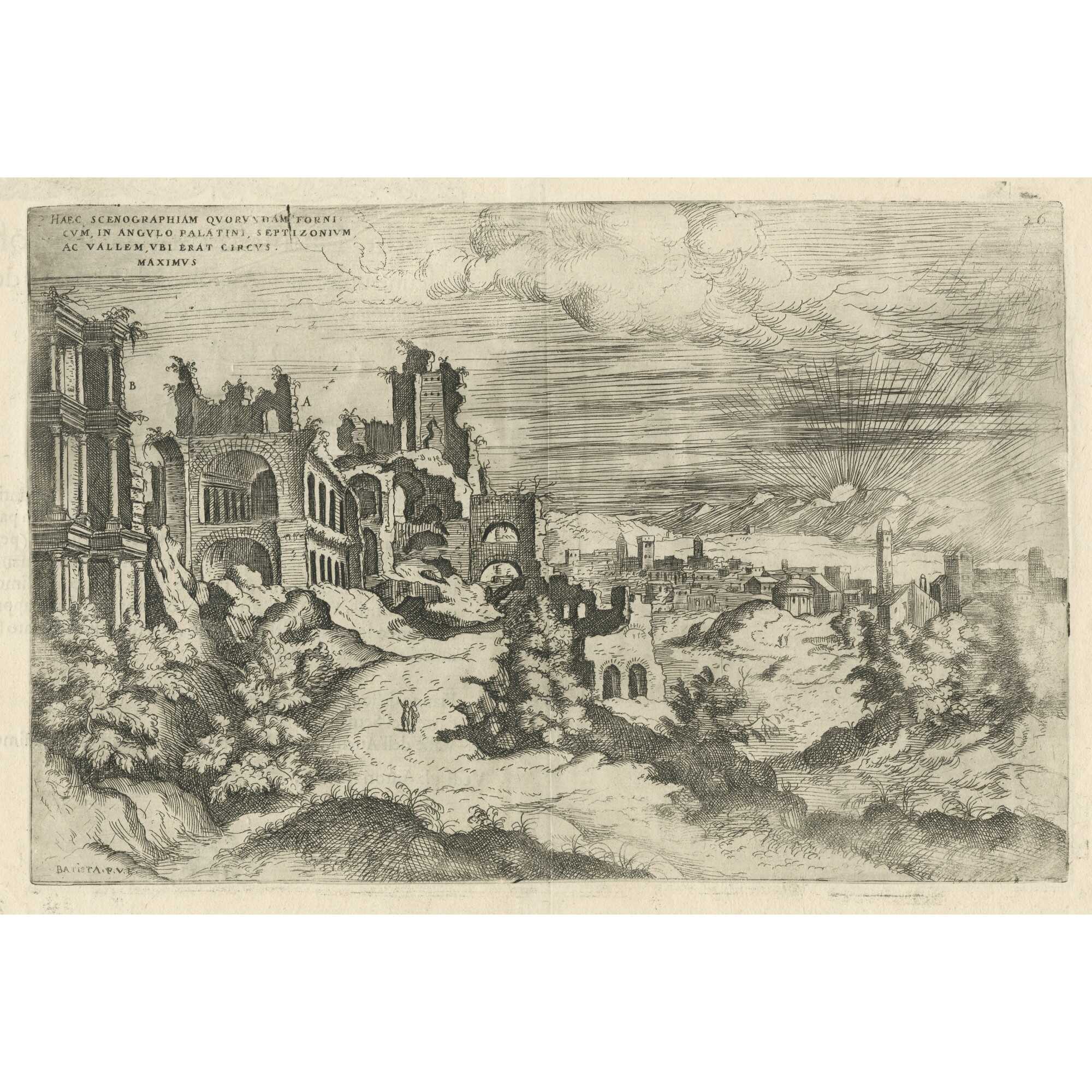
Giovanni Battista Pittoni the Elder. Ruins of the Septizonium and the Valley of the Circus Maximus (Tavola XXVI), after Hieronymus Cock, from Discorsi sopra l’antichità di Roma / Etching, 1582.
Etcher:Giovanni Battista Pittoni the Elder [called Vicentino] (Italian, 1520–1583) After:Hieronymus Cock (Netherlandish, ca. 1510/18–1570) Author: Vincenzo Scamozzi (Italian, 1548–1616)
Publisher: Francesco Ziletti (Italian, fl.1569–1587) Place: Venice Date: 1582 Medium: Etching on laid paper, book pages Dimensions: Sheet 320 × 430 mm; image 200 × 303 mm Signature: Lower left: BATISTA P.V.F. (Pittoni Vicentino Fecit)
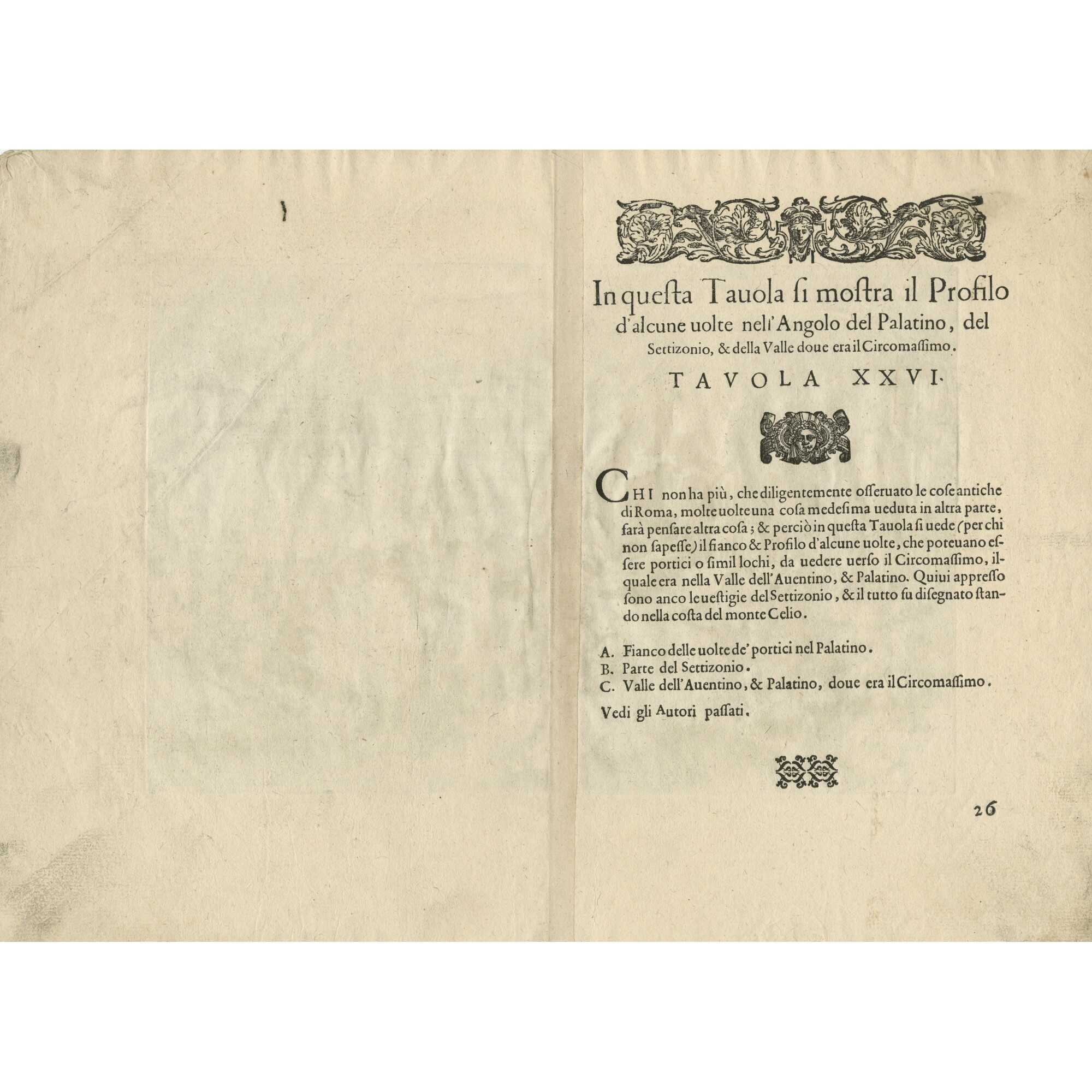
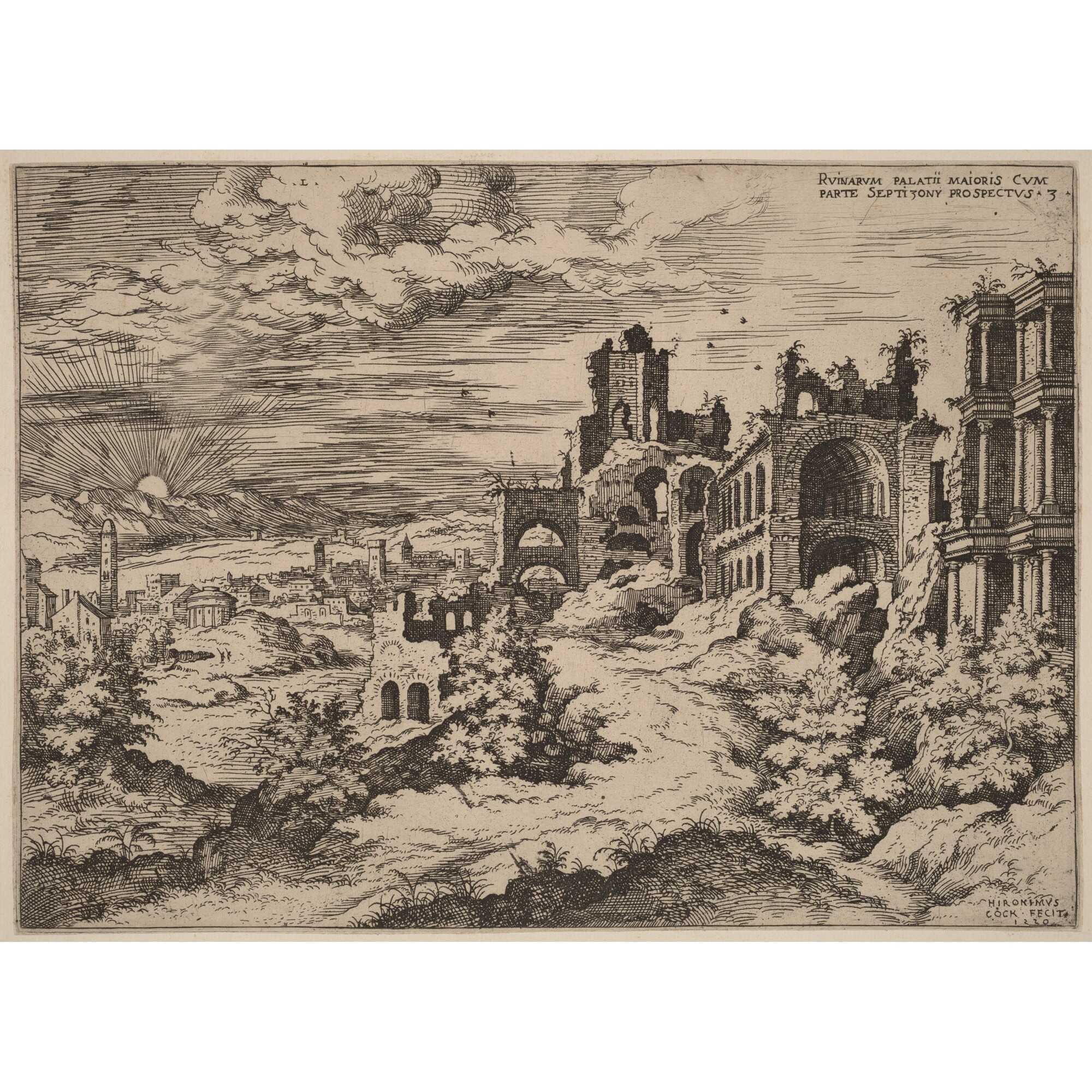
Description: Sheet formed from two conjoined leaves of cream laid paper (320 × 430 mm), margins untrimmed, from Vincenzo Scamozzi’s Discorsi sopra l’antichità di Roma (Venice: Francesco Ziletti, 1582). The etching was executed by Giovanni Battista Pittoni the Elder [called Vicentino] (1520–1583), not to be confused with Giambattista Pittoni or Giovanni Battista Pittoni (1687–1767), the Venetian painter of the late Baroque and Rococo period. On the recto, an etching (platemark 200 × 303 mm) depicts the ruins of the Septizonium at the corner of the Palatine Hill, with broken arcades and vaulted remains extending into the valley of the Circus Maximus. The composition reproduces in reverse (mirror image) Hieronymus Cock’s Ruinarum Palatii Maioris cum parte Septizonii prospectus 3 (Antwerp, 1550), but is distinguished by the addition of human figures in the foreground. Letter marks (“A”, “B”, “C”) engraved within the scene correspond to the explanatory key on the verso. The Latin inscription appears at upper left; the plate is numbered “26” at upper right; signed in the lower left BATISTA P.V.F. — (Pittoni Vicentino fecit). The conjugate verso bears a woodcut ornamental headpiece (interlaced scrolls and grotesque masks), a small decorative device (mask with volutes), and a tailpiece (floral scrolls with rosette), framing sixteen lines of explanatory text in Italian, paginated “26,” printed in roman type with frequent use of the long “s” (ſ). The conjugate leaf on the recto is blank. The plate was clearly derived from Cock’s design: its reversed orientation demonstrates that the copyist worked directly from the finished print, seemingly overlooking the fact that the etched plate would print in mirror. The addition of figures, explanatory lettering, and verso commentary suggests an attempt to adapt the composition into a didactic antiquarian series.
Inscription on recto, upper left: HAEC SCENOGRAPHIAM QVORVNDAM FORNI | CVM, IN ANGVLO PALATINI, SEPTIZONIVM | AC VALLEM, VBI ERAT CIRCVS | MAXIMVS (This is a view of certain vaults at the corner of the Palatine, with the Septizonium and the valley where once was the Circus Maximus.)
Text on verso: In questa Tavola si mostra il Profilo | d’alcune volte nell’Angolo del Palatino, del | Settizonio, & della Valle doue era il Circomassimo. | TAVOLA XXVI. | Chi non ha più, che diligentemente osseruato le cose antiche | di Roma, molte uolte una cosa medesima ueduta in altra parte, | farà pensare altra cosa; & perciò in questa Tauola si uede (per chi | non sapesse) il fianco & Profilo d’alcune uolte, che poteuano es- | sere portici o simili lochi, da uedersi uerso il Circomassimo, il- | quale era nella Valle dell’Auentino, & Palatino. Quivi appresso | sono anco le ruine del Settizonio, & il tutto fu disegnato stan- | do nella costa del monte Celio. | A. Fianco delle uolte de’ portici nel Palatino. | B. Parte del Settizonio. | C. Valle dell’Auentino, & Palatino, doue era il Circomassimo. | Vedi gli Autori passati. ||
Translation: In this plate is shown the profile of some vaults at the corner of the Palatine, of the Septizonium, and of the valley where the Circus Maximus once stood. Whoever has more diligently observed the ancient remains of Rome will often find that the same structure, seen from another place, will seem something else; therefore, in this plate one sees (for those who did not know) the side and profile of some vaults, which may have been porticoes or similar places, looking toward the Circus Maximus, which lay in the valley between the Aventine and the Palatine. Nearby are also the ruins of the Septizonium, and everything is drawn from the slope of the Caelian Hill. A. Side of the vaulted porticoes on the Palatine. B. Part of the Septizonium. C. Valley of the Aventine and the Palatine, where the Circus Maximus was. See the above-mentioned authors.
References: Hieronymus Cock, Ruinarum Palatii Maioris cum parte Septizonii prospectus 3, Antwerp, 1550; Hollstein 34. The Albertina Museum, Vienna, inv. DG1957/339/13 (Cock’s plate, also exhibited at The Metropolitan Museum of Art, New York). National Gallery of Art, Washington D.C., acc. no. 1994.80.14 (Ruins on the Palatine with a Panoramic Landscape). University of Chicago, Speculum Romanae Magnificentiae digital collection (for comparative context of numbered plates with verso explanatory texts).
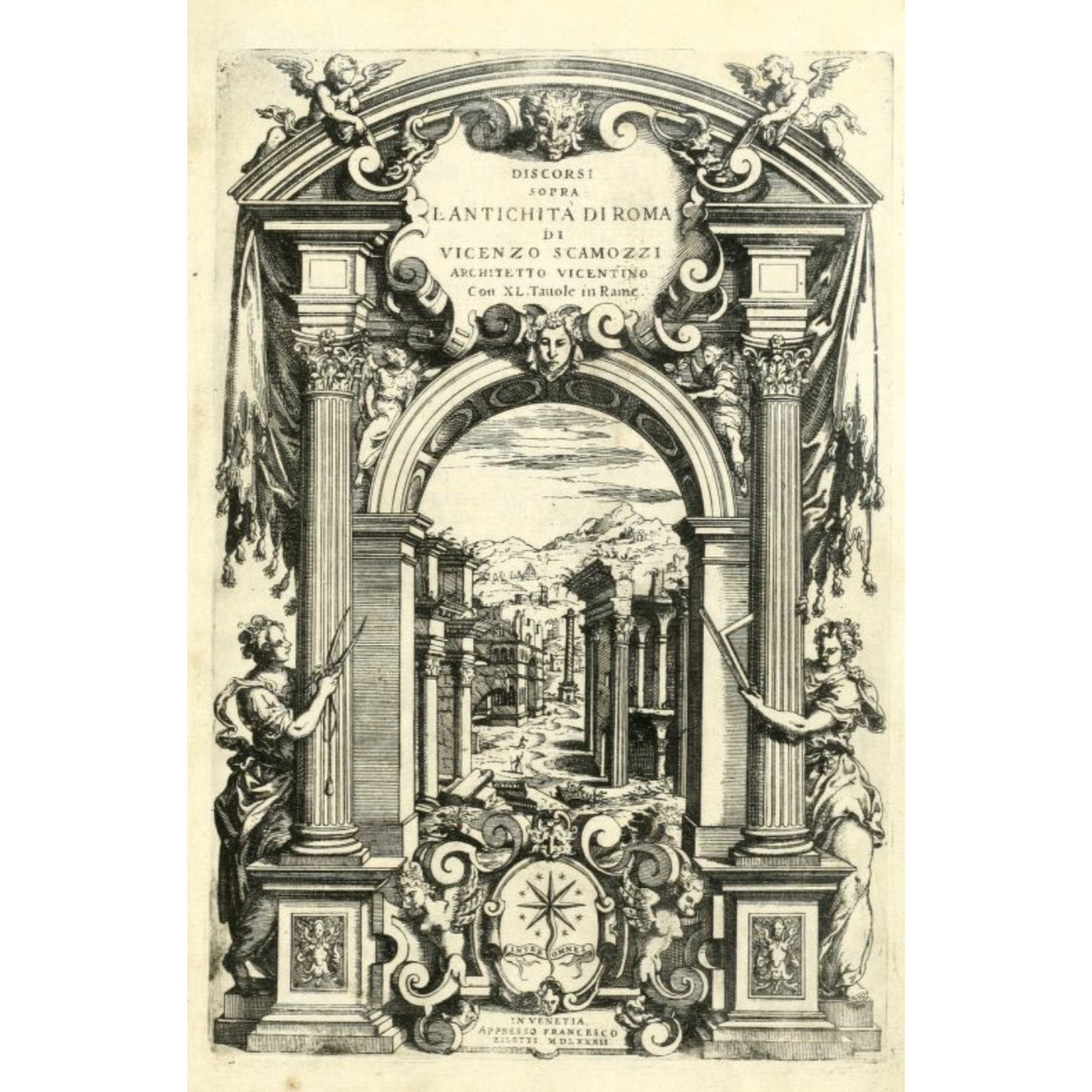
Discorsi sopra l'antichità di Roma. In Venetia: Appresso Francesco Ziletti, 1582.
Hieronymus Cock, Ruinarum Palatii Maioris cum parte Septizonii prospectus 3, Antwerp, 1550 / National Gallery of Art, Washington, DC
[SVE-0631.2025] Ruins of the Septizonium and the Valley of the Circus Maximus (Tavola XXVI), after Hieronymus Cock, 1570s.
Vincenzo Scamozzi. Discorsi sopra l’antichità di Roma. — Venice: Francesco Ziletti, 1582.