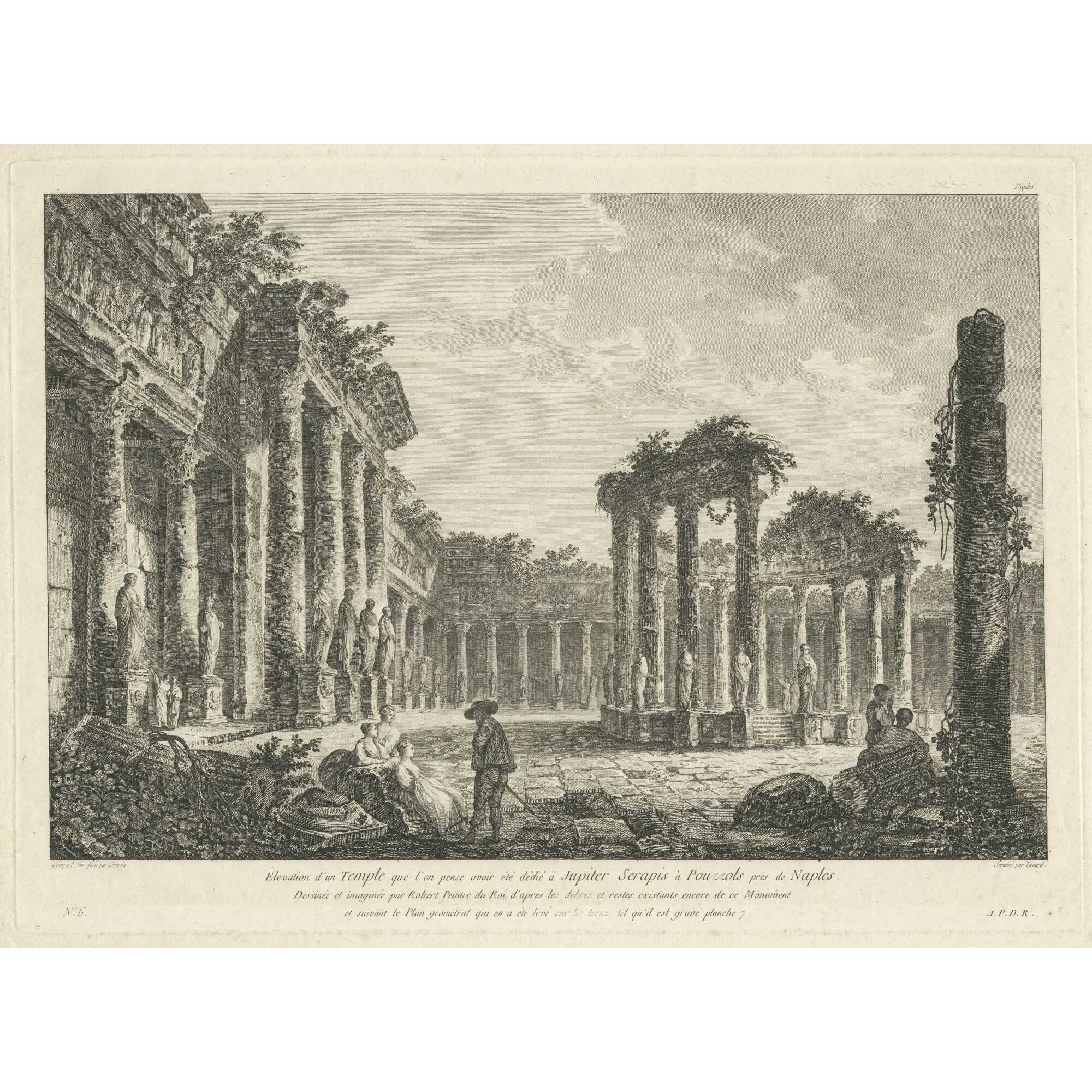
Etcher: Louis Germain (French, 1733 – c.1791)
Finisher: Jean-Baptiste Liénard (French, 1758–1810)
After: Hubert Robert (French, 1733–1808)
Publisher: Jean-Claude Richard, Abbé de Saint-Non (French, 1727–1791)
Printer: Jacques-Gabriel Clousier (French, 17xx–1804)
Source: Voyage pittoresque ou description des royaumes de Naples et de Sicile, vol. 2 (Paris, 1781–1786), chapter Jupiter Serapis à Pouzzols, pp. 167–169; accompanied by the Plan géométral du Temple de Sérapis on pp. 170–171.
Place: Paris
Date: 1781–1786
Medium: Etching on watermarked laid paper, finished by burin
Dimensions: Sheet 320 × 470 mm; platemark 265 × 367 mm; image 228 × 342 mm
Description:
Etching depicting the elevation of the Temple of Serapis at Pozzuoli (ancient Puteoli), near Naples. The temple is rendered with surviving Corinthian columns, collapsed entablature, and surrounding landscape, based on a design by Hubert Robert. Executed by Louis Germain and finished by Jean-Baptiste Liénard, the plate belongs to the monumental Voyage pittoresque ou description des royaumes de Naples et de Sicile (Paris, 1781–1786), a five-volume folio publication by Jean-Claude Richard, Abbé de Saint-Non, printed by Jacques-Gabriel Clousier. The series, among the most celebrated illustrated books of the eighteenth century, contains 278 plates (with one or two subjects each), 13 maps, and a plan, accompanied by Saint-Non’s descriptive texts. The work was issued in livraisons from 1778, with the text volumes published 1781–1786.
Inscriptions (all inside the platemark):
- Upper right: Naples
- Lower left: Gravé à l’Eau-forte par Germain
- Bottom left: No. 6
- Lower right: Terminé par Liénard
- Bottom right: A. P. D. R. (Avec Privilège du Roi)
- Center below the image: Élévation d’un Temple que l’on pense avoir été dédié à Jupiter Serapis à Pouzzols près de Naples. | Dessinée et imaginée par Robert Peintre du Roi d’après les debris et restes existants encore de ce Monument | et suivant le Plan geometral qui en a été levé sur les lieux, tel qu’il est gravé planche 7. (Elevation of a temple thought to have been dedicated to Jupiter Serapis at Pozzuoli near Naples. | Drawn and conceived by Robert, Painter to the King, from the debris and remains still existing of this monument | and according to the geometrical plan which was surveyed on site, as engraved in plate 7.)
Note:
The designation Jupiter Serapis does not refer to two distinct deities but to a syncretic form of worship in the Roman world, where the Greco-Egyptian god Serapis was identified with Jupiter (Zeus). Antiquarians of the seventeenth and eighteenth centuries often used the compound name when referring to the great ruin at Pozzuoli, now conventionally called the Temple of Serapis.
Catalogue Raisonné:
- Cohen-de Ricci, Guide de l’amateur de livres à gravures du XVIIIe siècle, nos. 928–930. [LIB-2541.2020]
- Gordon Ray, The Art of the French Illustrated Book 1700–1914, no. 34, pp. 63-68. [LIB-2424.2020]