
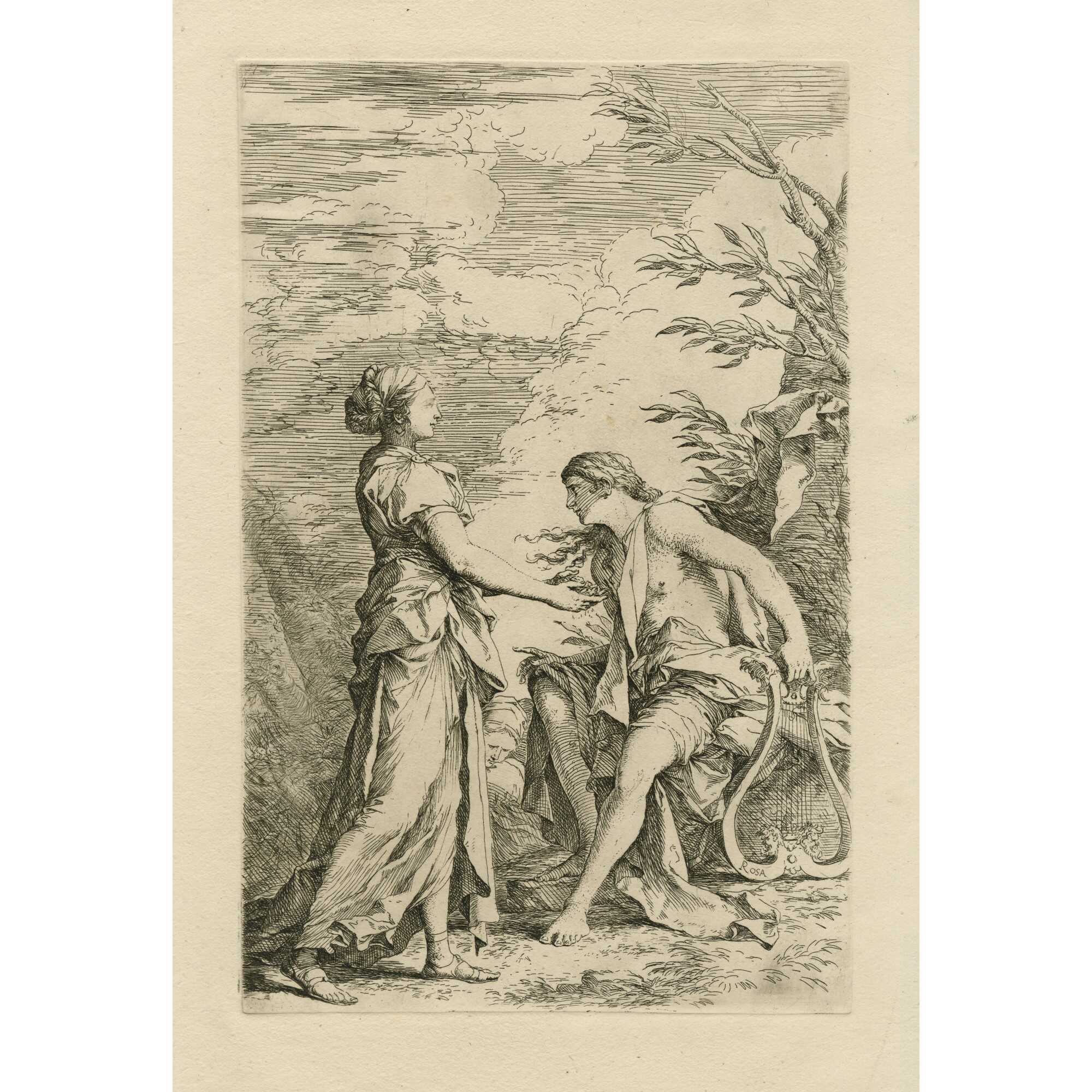
Artist: Salvator Rosa (Italian, 1615–1673)
Place/Date: Rome, c. 1661
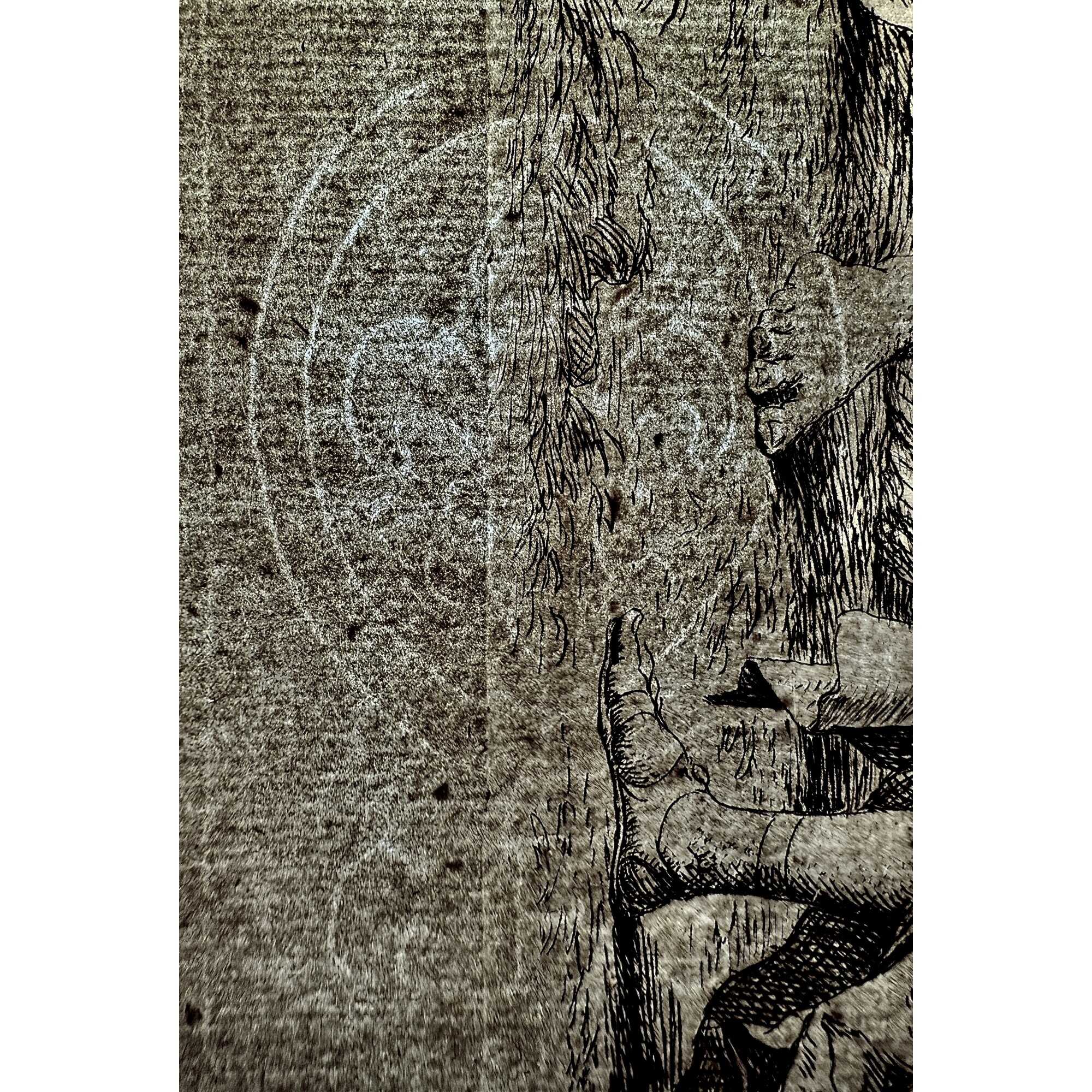
Medium: Etching with drypoint on laid paper; fleur-de-lis in a double circle watermark with three letters beneath (possibly G[F/E] and another, unidentified
Dimensions: Sheet 400 × 272 mm; platemark 338 × 217 mm
Inscriptions: At the base of the lyre at lower right: ROSA.
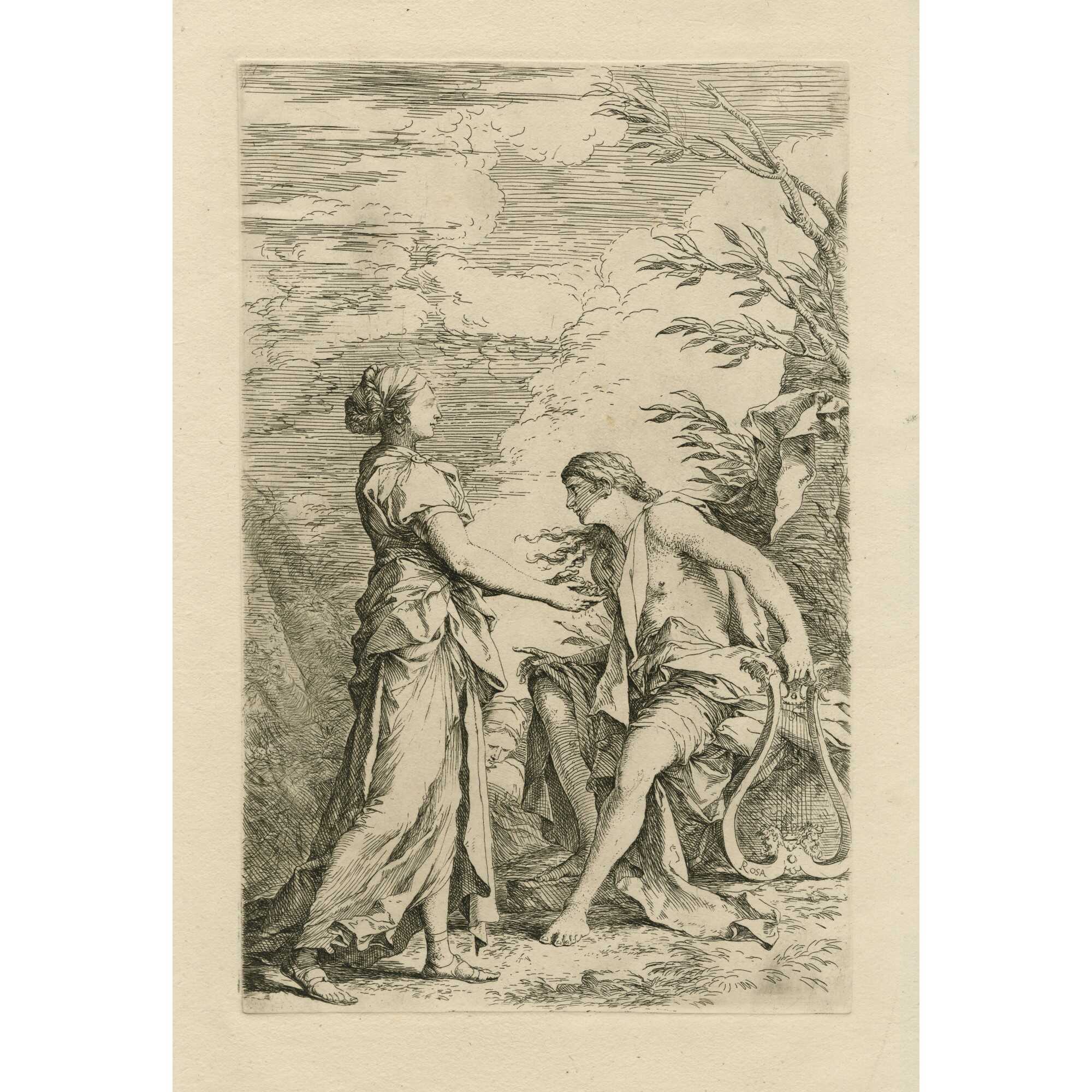
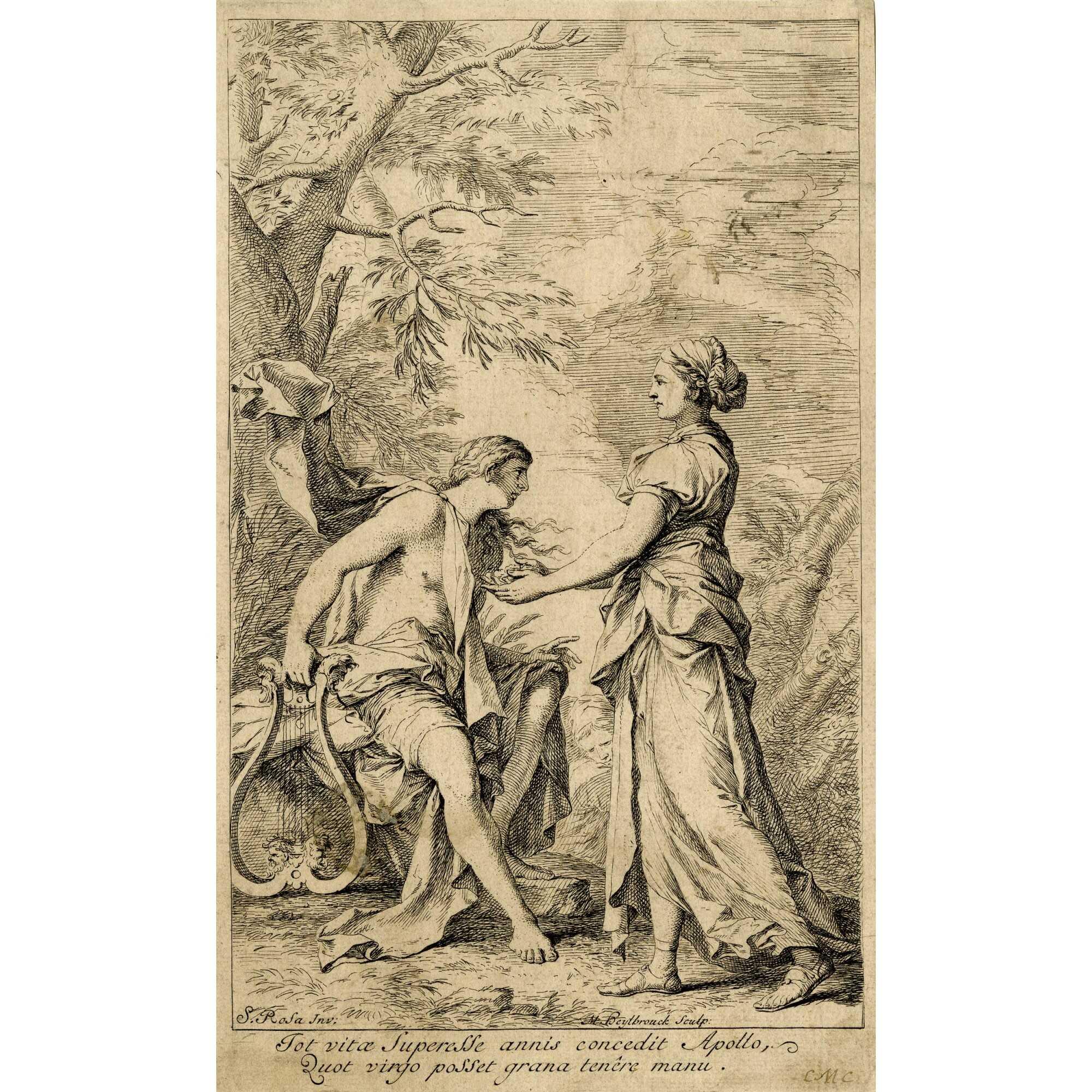
Description: Apollo, identifiable by the lyre at right, is paired with a female figure traditionally identified as the Cumaean Sibyl, set within a rocky landscape. Rosa’s wiry etched line is reinforced in passages with drypoint burr, especially in the darker accents and foliage.
Catalogue raisonné: Bartsch XX.274.17 – Apollon et la Sylille Cumée. La Sybille Cumée debout à gauche, demandant à Apollon qui est assis à droite, que le sable qu'elle porte dans ses mains soit changé en or. Le nom de Rosa est écrit au bas de la lyre d'Apollon. Hauteur: 12 p. 8 lign. Largeur: 8 p. (The Cumaean Sibyl stands at the left, asking Apollo, who is seated at the right, that the sand she carries in her hands be changed into gold. The name “Rosa” is inscribed at the base of Apollo’s lyre. Height 345 × Width217 mm)
Reference:
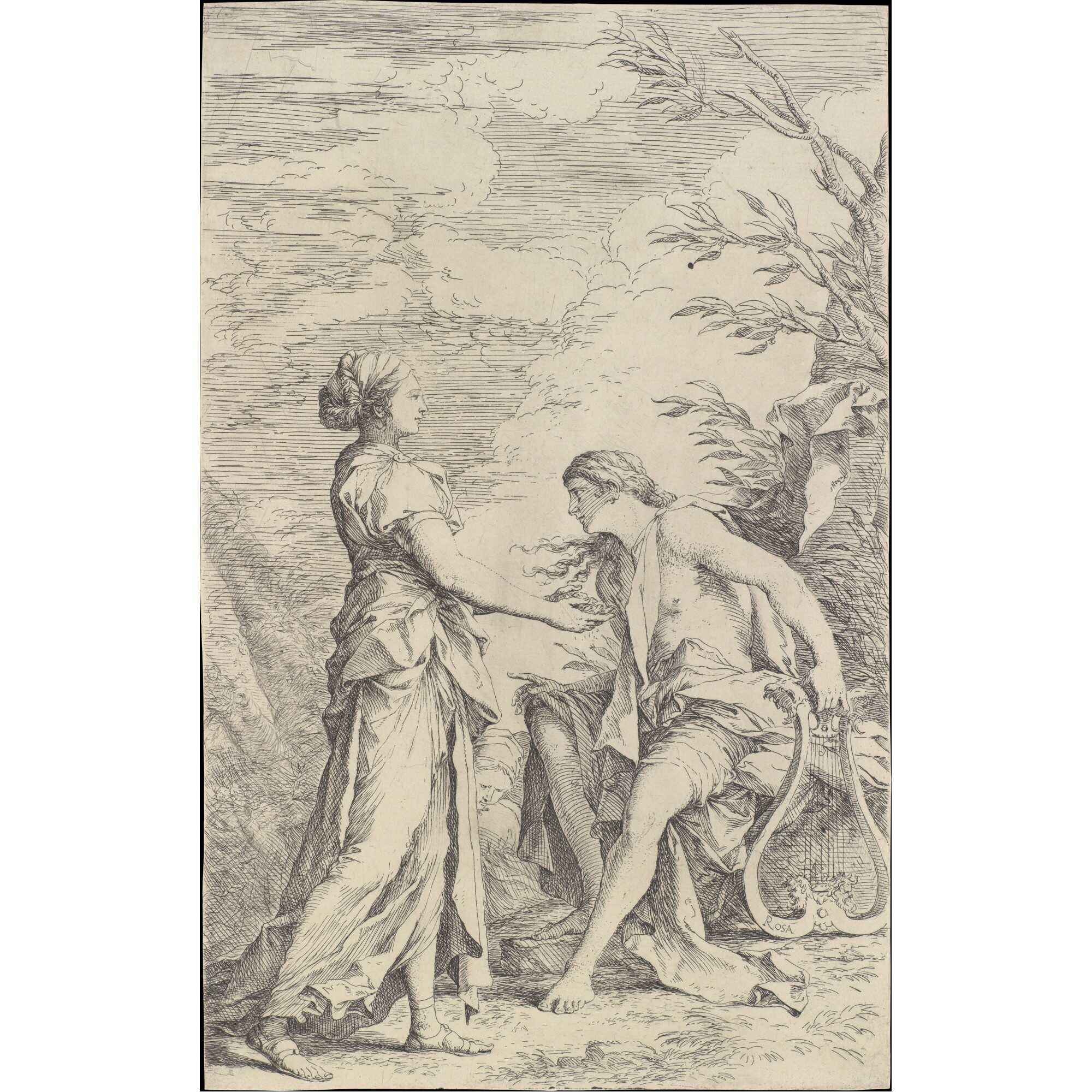
– Metropolitan Museum of Art № 17.50.17-88: Apollo and the Cumaean Sibyl, 340 x 215 mm.
– British Museum W,7.102: Apollo and the Cumaean Sibyl; a reduced copy in reverse after the etching by Rosa; to left, Apollo seated holding a lyre, to right, the Cumaean Sibyl standing and offering sand to Apollo to be changed into gold. Michiel Heylbroeck after Salvator Rosa; 1700-1730; Height: 231 mm; Width: 140 mm.
Watermark note: The present impression bears a watermark of a fleur-de-lis enclosed in a double circle, with three initials beneath (seemingly including “G” and “F” or “E”). This motif belongs to a group of 17th-century Italian papers associated with Fabriano and Genoese mills, frequently found in Roman prints of the mid-17th century. Comparable marks are recorded in Briquet (Les filigranes, nos. 7135–7145) and Heawood (Watermarks, nos. 1744–1752), many of which show the lily in a circle with initials such as GF, AG, or GGF. These parallels confirm that the sheet is printed on contemporary Italian paper of the type commonly used during Rosa’s lifetime.
 |
 |
 |
Additional Information
| Collection | European prints and drawings |
|---|---|
| Type / Purpose | |
| Period | 17 AD , Mid-17th century |
| Country | Italy |
| Media/Technique | Copperplate engraving , Engraving , Etching , Laid paper , Paper |
| Genre | Mythological Image |
| Subject | 17th century , Apollo (deity) , Cumaean Sibyl , Engraving , Europe , Greek mythology , Italian art , Italy , Lyre , Mythology , Roman mythology , Sibyl |
| Creation / Publishing year | 1661 |
| Acquisition year | 2025 |
Related Items


