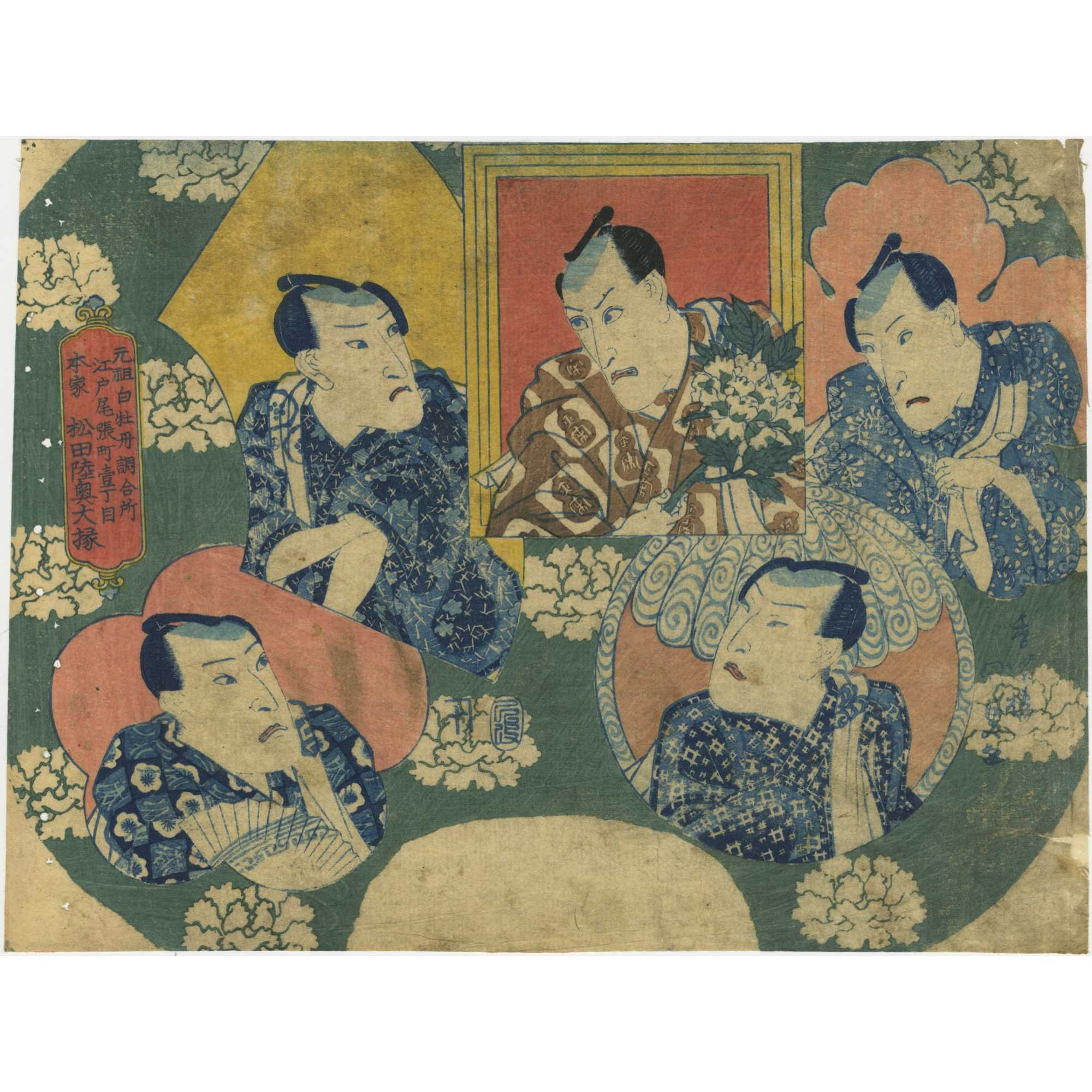
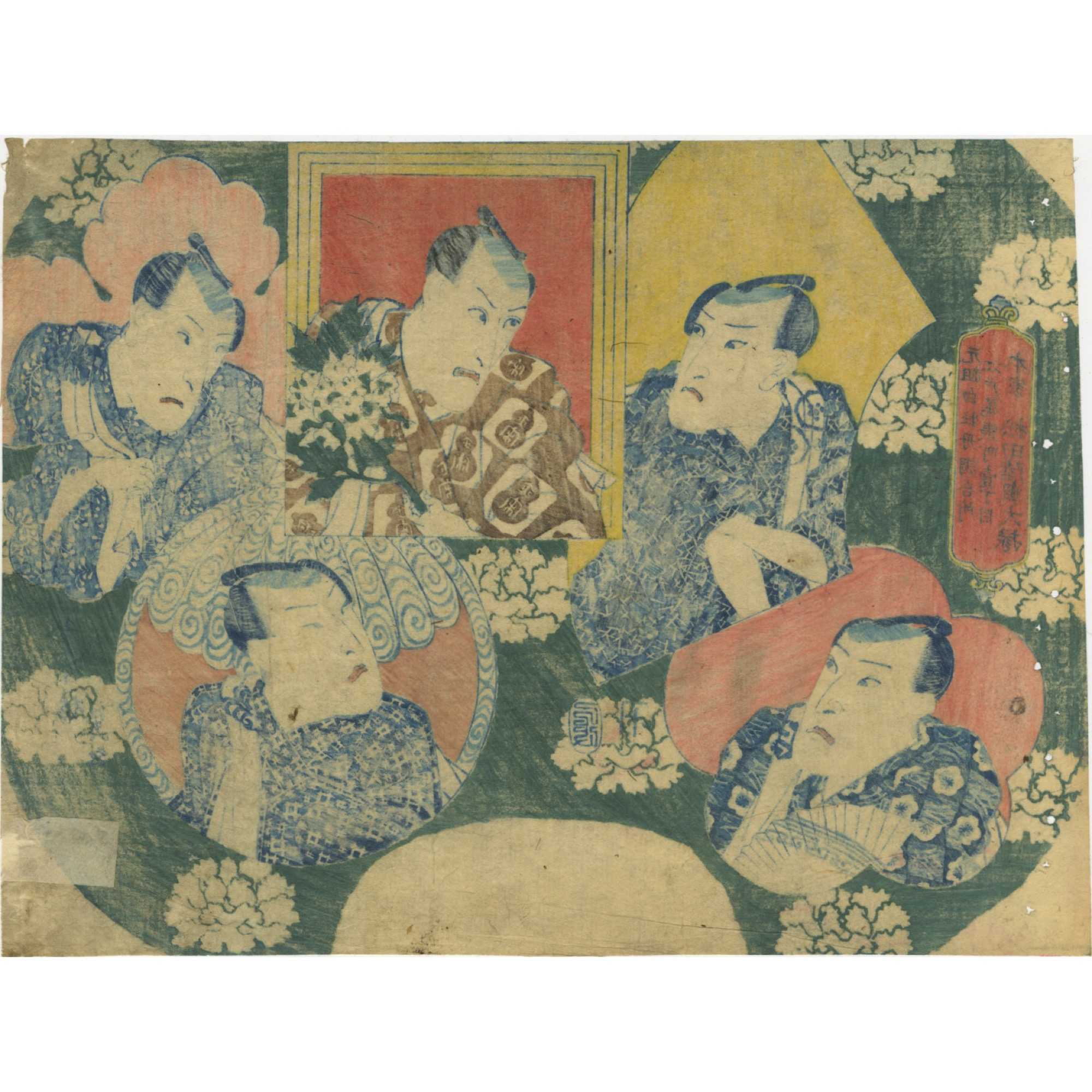
Color woodblock print for a rigid fan (uchiwa-e), 210 × 281 mm. Advertising fan print for the face powder Shirobotan (白牡丹, "White Peony"), manufactured by Matsuda Mutsu-no-Daijō (松田陸奥大掾) of Edo Owarichō Itchōme (江戸尾張町壱丁目).
Background. Dark green ground scattered with white peony blossoms throughout.
Portraits. Five bust portraits of kabuki actors, identified by likeness and family crest (mon), in variously shaped reserves (from top left to bottom right):
(1) Onoe Kikugorō III (尾上菊五郎, 1784–1849): folding fan-shaped reserve, yellow ground; blue kimono; white neck towel (手拭, tenugui) with the "Seven Luminaries" (shichiyō, 七曜) mon.
(2) Ichikawa Ebizō V (市川海老蔵, 1791–1859): rectangular reserve with three nested squares (mimasu, 三升) gold frame, red ground (center top, focal point of the composition); brown kimono with white rectangular medallions enclosing double-gourd (hyōtan, 瓢箪) motifs, each enclosing the seal-script character 窣 (sotsu/sū, "to dart out suddenly"), a personal emblem of the actor; holding a white peony in his right hand.
(3) Bandō Mitsugorō IV (坂東三津五郎, 1802–1863): paper mulberry leaf-shaped reserve (kaji-no-ha, 梶の葉), pink ground; blue kimono; white neck towel with mulberry leaf mon.
(4) Nakamura Shikan II (中村芝翫, 1796–1852): plum blossom-shaped reserve (ume, 梅), pink ground; blue kimono; white neck towel with plum blossom mon.
(5) Sawamura Gennosuke II (沢村源之助, 1802–1853): circular reserve in the shape of the half-chrysanthemum mon (kangiku, 寒菊), pink ground; blue kimono with well-crest (izutsu, 井筒) mon; white neck towel.
Advertising cartouche (upper left). Red ground with gold border; three columns: 元祖白牡丹調合所 (Ganso Shirobotan Chōgasho); 江戸尾張町壱丁目 (Edo Owarichō Itchōme); 本家松田陸奥大掾 (Honke Matsuda Mutsu-no-Daijō). This may be translated as: The Original Shirobotan Compounding Shop; 1st
District, Owari-cho, Edo; The Head Family Matsuda, Mutsu-no-Daijo.
Inscriptions. Center: publisher's mark 十 (Kojimaya Jūbei) and combined date/censor seal mi/aratame (巳/改), 1833. Right center: artist's signature 香朝樓國貞画 (Kōchōrō Kunisada ga). Binding holes along the left margin.